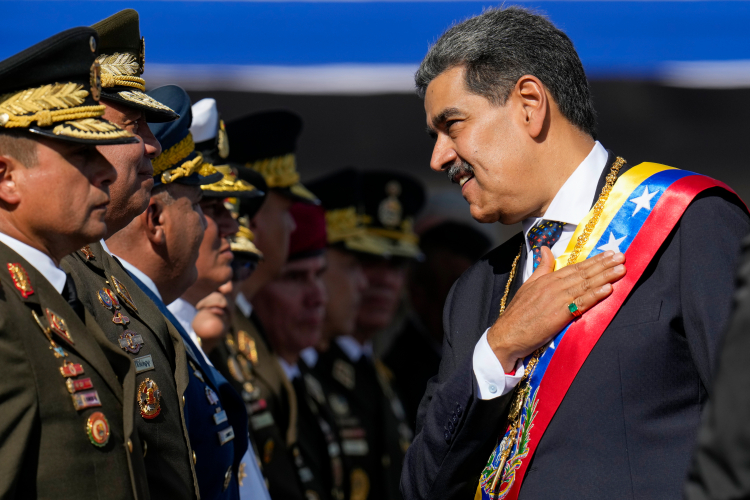
Many opponents of so-called Bolivarian socialism welcomed the capture and arrest of Nicholas Maduro. Yet, while rejoicing in the fall of a tyrant, one cannot help but share an important observation: the liquidation of a leadership through external intervention does not automatically mean a change in the regime or the country's trajectory of development. The example of Iraq – which, after the overthrow of Saddam Hussein, collapsed into the chaos of ISIS and then effectively fell under Iranian influence – is a clear confirmation of this. One can only hope that Venezuela does not fall into the same trap.
Ultimately, everything depends on what “human material” we have on the ground. It is important to note a characteristic feature of present-day dictatorships: unlike the tyrants of the last century (Stalin, Hitler, and others), modern dictators are much craftier. They do not close the borders; instead, they use every means possible to squeeze not only dissenters but all critically minded people out of their countries (while other states are not exactly eager to accept these refugees). During the years of so-called Bolivarian socialism, as the Venezuelan economy was destroyed by state control and state redistribution schemes, nearly 8 million people left the country. This is perhaps the largest displacement of people since World War II; even the Ukrainian emigration after the 2022 Russian invasion has not produced such impressive figures of refugees.
By now, inside Venezuela, three main groups remain:
• The upper and lower state bureaucracy; these are the Venezuelan nomenklatura – the cadre that was raised within the bubble of Bolivarian Socialism (a version of national socialism that represents the ideological cocktail of Marxian socialism and Venezuelan nationalism)
• The army, police, and Cuban controlled secret police
• An impoverished and poorly educated populace existing on shrinking government handouts.
Such social composition represents a fairly reliable foundation for the dictatorship. Today, there are hardly any businessmen or other enterprising people left in Venezuela.
The squeezing out method was first tested on a mass scale by Fidel Castro in the 1980s, when he started systematically kicking out all entrepreneurial and critically-minded people out of a country, leaving only a silent majority ready to put up with his rule. We observed the same tactic in Russia when, after her 2022 invasion of Ukraine, more than a million of her highly educated, tech savvy, and critically-minded citizens left the country. The same has been happening in Zimbabwe since the early 2000s.
Thus, modern dictatorships (with the exception of North Korea) are regimes of a new type. They engage in “social selection,” leaving behind “obedient sheep” ready to be “sheared” and listen to their "shepherd" without asking any questions. Based on this, Venezuela's prospects after Maduro's capture look somewhat uncertain.
It is notable that in his statement regarding the American special operation, Trump suggested that Venezuela be under direct U.S. control until a new government and civil society are formed there. What he meant by this, no one knows. Whether the country will become a “second Iraq” sliding into violence, or whether life can be breathed back into it, only time will tell.
On one hand, Trump showed the world that he can surgically excise a "cancerous tumor." On the other, he demonstrated to the isolationist part of his electorate his loyalty to the Monroe Doctrine: he is signaling that, formally, U.S. interests are limited to the Western Hemisphere. However, the American general who led the operation hinted transparently at a press conference regarding Maduro's capture that similar geopolitical "surgery" might be tested in the future. He did not specify if this “surgery” will be restricted by the Western Hemisphere.
Europe is watching what is happening with astonishment. On one hand, they are happy about the elimination of one of the main regional bullies. On the other, voices are heard from there saying that one should have acted "peacefully" and that formal international rules should not have been violated. Most amusing was the reaction from Moscow (the country responsible for the invasion of Ukraine), which issued a statement angrily condemning "illegal aggression" and calling for the respect of sovereignty.
The ball is now definitely in China's court, which also condemned Maduro's capture in harsh tones; we shall see what happens with Taiwan and whether Trump will go beyond the bounds of his isolationism in defending that island.
The chronology of the Venezuela downfall into the rabbit hole of “Bolivarian Socialism”:
1992 Venezuela became the third richest country in the Western hemisphere; the number one country in the world in terms of explored oil reserves ready for drilling
2001 Driven by the passion for the redistribution of wealth during free elections, the majority of Venezuela people voted for socialist president Hugo Chavez, a charismatic career military officer turned politician
2004 Private health care was totally nationalized by the government, oil money was used to fund it
2007 Higher education was declared free of charge, oil money was used to fund it
2008 Chavez’s United Socialist Party of Venezuela (PSUV) became the major political party; penetrating all fabric of society, it eventually took over entire power in the country and since then has never shared power with any other political force
2009 Venezuelan socialists banned private ownership of any firearms
2011 Bernie Sanders, a prominent U.S. socialist politician, praised Venezuela for resolving income inequality, stressing that the American dream was more apt to be realized in such countries as Venezuela rather than in the United States
2012 Hugo Chavez, the founding father of Bolivarian Socialism, died. Nicholas Maduro, his loyal lieutenant and career socialist bureaucrat with a working class background, took over
2014 The leaders of democratic opposition to the ruling United Socialist Party of Venezuela (PSUV) were locked in prison
2014-2015 Declining oil revenues (due to the mismanagement of nationalized oil industry and the worldwide drop of oil prices) coupled with generous social programs ruined the country’s economy and led to hyperinflation and shortages
2016 Shortages of regular foodstuffs and the medication/medical services became a chronic part of Venezuelan life
2017 Venezuelan Constitution and free elections were terminated
2019 More than 9,000 dissidents and demonstrators were executed by the Venezuela secret services and police for “resistance to authority.”
2024 Nicholas Maduro falsified presidential elections and declared himself the president; tens of thousands of opposition activists were able to collect copies of 83% of the voting tallies (long printouts resembling receipts), which showed that Maduro had in fact won only 30% of the vote, compared with 67% for the democratic opposition candidate named Edmundo González
Read Full Article »