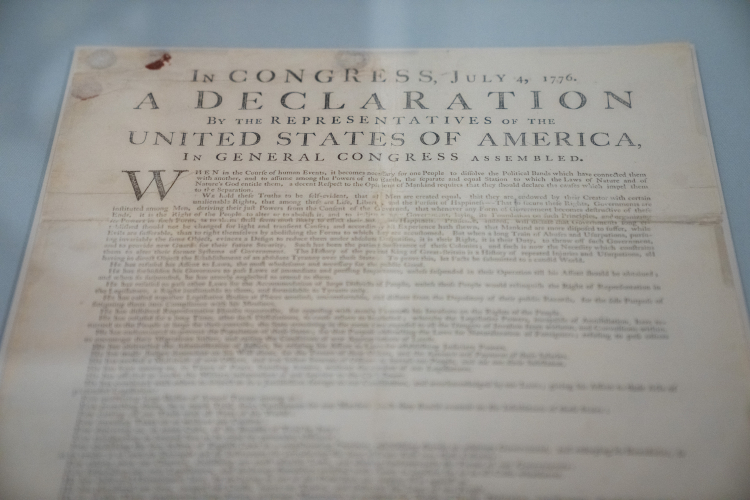
No, the Continental Congress did not first vote for independence on July 4, 1776. Seven weeks earlier, on May 15, Congress authorized the thirteen former colonies to adopt constitutions and establish sovereign state governments. This authorization was a de facto declaration of independence. The newly formed states assumed the exclusive right to govern, make laws, and manage internal affairs. Radically, the resolution required each state to replace King George III with the people as the supreme sovereign.
Talk of independence was in the air as the Revolutionary War entered its second year. John Adams worried the colonies would declare independence before the Continental Congress. He complained the Congress was “consumed upon trifles” and that it “could only now and then snatch a transient Glance at the promised Land [independence].” Two colonies, New Hampshire and South Carolina, replaced their royal governments with new state governments a few months earlier, on the condition that they not reconcile with Britain. The Virginia convention voted on May 15th to draft a constitution that included a declaration of rights.
After much debate, the Continental Congress passed a one-sentence resolution on May 10 authorizing the colonies “to adopt such Government as shall …best conduce to the happiness and safety of the Constituents.” Congress named a committee comprising John Adams, Edward Rutledge, and Richard Henry Lee to compose an explanatory preamble.
John Adams took the lead and drafted a preamble explaining the grievances that necessitated the formation of independent state governments. Its wording proved contentious. Several delegates believed Congress was moving too hastily toward independence. Braxton Carter, a prominent tidewater Virginia planter, complained the combined preamble and resolution fell “little short of independence.” New York delegate James Duane expressed similar disapproval, arguing the resolution asserted independence.
Despite opposition, proponents carried the day five days later. The resulting preamble blamed the King and Parliament for ignoring their petitions, denying civil rights, and causing destruction with the aid of mercenaries. As a result, the dispute is “absolutely irreconcilable,” and “all authority under the said Crown should be totally suppressed.” This was in effect an assertion of independent self-government.
John Adams characterized the combined preamble and resolution as “an Epocha, a decisive event,” the most importantResolution ever taken in America. Writing to Abigail Adams two days later, the Massachusetts delegate boasted, “Great Britain has at last driven America to the last Step, a compleat Separation from her, a total absolute Independence, not only of her Parliament but of her Crown, for such is the Amount of the Resolve of the 15th.” Other delegates expressed their agreement in letters to their constituents. Virginian Richard Henry Lee wrote that the resolution “gladdened the heart of every friend to human nature.”
News of the resolution spread quickly. The Pennsylvania Gazette published the preamble and resolution seven days later. Within a few weeks, newspapers in Boston, Baltimore, Williamsburg, New York, Connecticut, and New Hampshire reprinted Congress’s instructions to the states.
With the new resolution in hand, states began drafting constitutions and establishing sovereign governments. Virginia and New Jersey established republican governments before the July 4th Declaration of Independence. Other states followed a more deliberate process. By the end of 1776, seven additional drafting conventions had adopted new state constitutions, and Connecticut and Rhode Island had amended their colonial charters to remove all references to the King and Parliament.
Marking the end of British government in the thirteen colonies, the May 15th resolution was the groundbreaking declaration of sovereignty and the prerequisite for the formation of new state governments. Adams and the other delegates understood its importance. He recounted a conversation with an opposition delegate who “called it, to me, a Machine for the fabrication of Independence. I said, smiling, I thought it was independence itself: but We must have it with more formality yet.” Hence, congressional delegates knew that a vote for the May 15th resolution was a vote for independence, and the only remaining action was to proclaim America’s independence to the world through a public declaration.
Read Full Article »