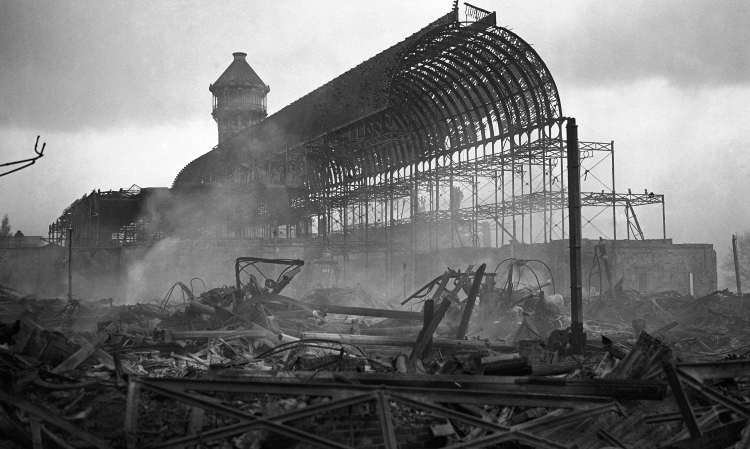
This year marks the 90th anniversary of the loss of an architectural wonder in South London. At 7:30 p.m. on Nov. 30, 1936, staff reported that fire had broken out at the vast Crystal Palace at Sydenham Hill, Upper Norwood. This Victorian glass and iron masterpiece, opened by Queen Victoria in 1854, faced catastrophe.
A force of 438 firefighters and 88 fire engines attempted to fight the conflagration, but strong westerly winds fed the fire beyond all control. Interior wood flooring and fittings soon fueled the blaze. Flames leapt hundreds of feet high. First, the 384-foot-long glass transept disintegrated with a roar, then fire consumed 10 interior exhibition courts and the rest of the iconic 6-story-high structure. Large crowds gathered throughout the night to watch the unfolding cataclysm. The red glow was visible from 50 miles away.
The next morning, press biplanes flew over the site photographing the ruin, revealing a smoking skeleton of molten glass and iron debris. The Palace’s two 282-foot-high water towers — designed by Isambard Kingdom Brunel — remained defiantly untouched. On the terraces behind the Palace, the marble bust of its visionary architect, Sir Joseph Paxton (1803-1865), gazed impassively at the loss of his prized creation. The exact cause of the fire was never established.
In the immediate aftermath, Londoners mourned the destruction of the Crystal Palace as a vanished symbol of the Victorian age. Then in 1941, as the Blitz hit London, government engineers using explosives added insult to injury. They demolished Brunel’s two water towers to prevent their use as a navigation reference point by raiding German bombers.
In the following decades, the empty parkland and grand stone terraces in Sydenham where the Palace once stood became overgrown, neglected and placed on Britain’s Heritage at Risk Register. In 2015, ambitious plans by a Chinese billionaire to rebuild the Crystal Palace evaporated in the face of London planning regulations and determined local opposition.
But in May 2026, rebirth is finally in the air. Since May 2025, Crystal Palace Park, the 200-acre green space that once hosted the Palace, has undergone an extensive multimillion-pound regeneration project, co-delivered by the local Bromley Council and Crystal Palace Trust. Today, 90 years on from the loss of the Crystal Palace, restoration works funded by the National Lottery Heritage Fund and Historic England are nearing completion.
Victorian Visionary
The current restorations are a worthy tribute to a Victorian architectural genius. Born the son of a farm laborer in 1803, Joseph Paxton became a pioneer of prefabricated glass and garden greenhouse design. As head gardener to the Duke of Devonshire at Chatsworth House, Derbyshire, from 1826, he developed a series of revolutionary glasshouse designs. His singular vision was to apply them on a far grander scale than ever previously achieved.
Paxton submitted winning designs for a "Crystal Palace," the centerpiece hall of Britain’s Great Exhibition, opening in 1851 in Hyde Park. Constructed in only nine months using Paxton’s prefabricated modular cast-iron components and 293,000 panes of glass, the 1,851-foot-long Crystal Palace was an architectural marvel. Encompassing 990,000 square feet and standing 128 feet high, London had never seen anything like it. It was an icon of modernity. It stood as the world's first large-scale modular glass building, embodying Britain’s Victorian spirit of industrial progress and reputation as the manufacturing "Workshop of the World." In his commemorative poem, "The Crystal Palace," William Makepeace Thackeray memorably described it: "A blazing arch of lucid glass / Leaps like a fountain from the grass." During its opening from May to October 1851, over 6 million people visited the Exhibition to see its showcase contents, an astonishing one-third of the entire British population.
The Crystal Palace was dismantled in Hyde Park after the Exhibition ended. Refusing to let the Palace disappear, Paxton formed the Crystal Palace Company and purchased parkland on Sydenham Hill, South London. Between 1852 and 1854, the Crystal Palace was re-erected and enlarged in Sydenham within a Victorian pleasure park also designed entirely by Paxton.
To form the plinth of the reassembled Palace, Paxton designed and constructed a series of Italian Terraces, grand, formal stone steps, balustrades, and platforms. The upper and lower terraces featured formal parterres, intricate masonry and more than 100 specially commissioned statues. They overlooked massive fountains inspired by the Palace of Versailles outside Paris and powered by two water towers designed by fellow Victorian architectural and engineering genius Isambard Kingdom Brunel.
Further down the hill, Paxton installed the famous Geological Court, parkland featuring life-sized dinosaur sculptures sculpted by Benjamin Waterhouse Hawkins. These models represented the world’s first scientific attempt to visualize extinct dinosaurs. The Crystal Palace and its pleasure gardens subsequently became a center for exhibitions, concerts, firework displays and mass public entertainment.
Sir Joseph Heads Home
In May 2025, Bromley Council and the Crystal Palace Trust gave the green light for a multimillion-pound transformation of Crystal Palace Park. Set for final completion by late summer 2026, this initiative aims to permanently remove the park's historic assets from the Heritage at Risk Register. Extensive restoration works included structural and stonework repairs, masonry cleaning and conservation of the surviving balustrades. Gardeners have landscaped a new wildflower meadow, and two accessible walkways were constructed to connect the lower grounds directly to Crystal Palace Parade. Also underway is restoration of the 30 dinosaur sculptures in the park and its surrounding lakes. A new Visitor Center and entrance gateway at Penge are set to open. Among the park's other restored monuments is the imposing Sir Joseph Paxton Bust. Sculpted from Italian Carrara marble by William Frederick Woodington in 1869, the 8-foot-high bust was originally unveiled on the upper terraces in June 1873 in Paxton’s memory. After the 1936 fire, workers moved it to a car park. In 1981, it was re-erected facing the nearby Crystal Palace National Sports Centre, which opened in 1964. Over the following years, it became weathered and stained by pollution. This month, stone conservators have completed the bust’s final restoration to pristine condition. On May 9, 2026, a team lifted the sculpture and returned it by truck to its original site.
Ninety years on from the catastrophe which destroyed Paxton’s famous creation, this striking memorial to a revered architectural visionary of the Victorian age is finally back, where it belongs.
Read Full Article »