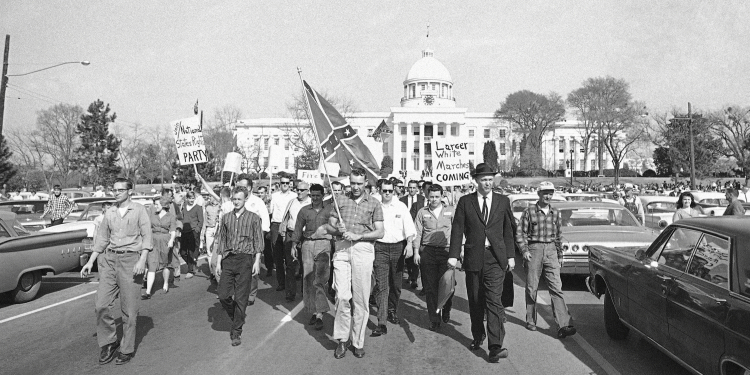
One region of America is never fully allowed to move on from its past.
America rightly examines difficult chapters of its history. Every region has sins, failures, and injustices that deserve honest study. New England profited from the slave trade. Northern cities practiced segregation and discriminatory housing policies well into the twentieth century. Western expansion came at tremendous cost to Native American peoples. Yet no region's history remains under such persistent public scrutiny as that of the South.
There's a reason for that.
The Civil War was the deadliest conflict in American history, fought largely over slavery – an institution that denied millions of human beings their freedom and dignity. The moral clarity of slavery in hindsight, combined with the Civil Rights movement a century later, ensured the Confederacy would become the nation's defining symbol of racial injustice.
That historical reality cannot be ignored. Nor can the century that followed.
The South was home to Jim Crow laws, disenfranchisement, racial violence, and organized resistance to civil rights reforms. Lynchings occurred with horrifying frequency, and many Southern political leaders fought to preserve systems that denied equal treatment under the law. These facts give Southern history a moral weight that cannot simply be dismissed as misunderstanding or stereotype.
Yet acknowledging that history does not require accepting that an entire region, its descendants, or its culture should remain permanently defined by its worst chapters. If we believe people can grow, institutions can reform, and nations can evolve, then the same principle must apply to regions.
The Confederate government explicitly sought to preserve a social and economic system built on slavery. The secession declarations of several Southern states leave little doubt about that. Any honest discussion of the Civil War must acknowledge it plainly. But acknowledging that truth is not the same as accepting a simplified version of history.
A war involving millions cannot be fully understood through politicians' motivations alone. While slavery was central to secession, individual soldiers' motivations were often far more personal and immediate. Many fought because their states seceded. Others enlisted because their communities expected it, because family members joined, because their homes were threatened, or because they believed they were defending their region and way of life as they understood it. History becomes less accurate when we assume every Southern soldier marched off for the same reason or shared identical beliefs. Human beings rarely fit neatly into modern political categories, and neither do the people who lived through America's bloodiest conflict.
Modern Americans often struggle to separate remembrance from endorsement. Honoring an ancestor isn't the same as endorsing every cause that ancestor served. Families preserve photographs, letters, uniforms, gravesites, and stories because they are a part of their history. Most descendants aren't defending every political decision made in 1861. They're remembering people, not governments.
That distinction matters because a society that refuses to remember imperfect people ultimately loses the ability to understand itself. History shouldn't require approval to be remembered. The purpose of history isn't to identify saints and villains but to understand the people and events that shaped the nation we inherited.
What makes the Southern experience unique isn't simply the existence of historical wrongdoing – every region has that. What sets the South apart is that its failures often overshadow everything else in the public imagination.
Critics rightly note that many Confederate symbols experienced renewed prominence during the Jim Crow era and again during resistance to the Civil Rights movement. That history deserves acknowledgment and, in many cases, condemnation. Yet even that reality raises a broader question: how should a society remember a complicated past? Erasing every symbol does not erase history, and preserving every symbol does not automatically endorse it. The challenge is finding a way to remember honestly without reducing entire communities or generations to a single historical judgment.
The South's modern challenges also cannot be understood apart from its economic history. The devastation of the Civil War, the uneven results of Reconstruction, decades of agricultural dependence, persistent rural poverty, and slower industrial development left deep structural disadvantages across much of the region.
While Southern leaders bear responsibility for many policy failures, economic conditions were also shaped by forces extending beyond state borders: national investment patterns, federal policies, and shifts in global markets. Understanding these realities doesn't excuse the South's shortcomings, but it does help explain why some problems proved more persistent than simple stereotypes suggest.
That doesn't mean every criticism of the South is invented. Parts of the region continue to struggle with poverty, educational attainment, health outcomes, crime, and social mobility. Some of those challenges are measurable and persistent. Ignoring them would be just as dishonest as ignoring the region's contributions.
The scale and duration of racial injustice in the South help explain why the region remains a focus of national attention. Jim Crow lasted for generations, and resistance to civil rights often occurred in highly visible ways that became embedded in America's collective memory. It would be unrealistic to expect those events to fade quickly or to carry no continuing influence on how the South is perceived. The question is not whether this history should be remembered, but whether remembrance should become the sole lens through which an entire region is viewed.
But those realities don't tell the whole story.
The region that gave America the blues, jazz, country music, bluegrass, and much of its gospel tradition is often reduced to a stereotype. The homeland of writers like William Faulkner, Flannery O'Connor, Walker Percy, Eudora Welty, Harper Lee, and Robert Penn Warren is frequently dismissed as culturally backward. The South has supplied generations of military volunteers, entrepreneurs, educators, ministers, artists, and public servants who helped shape the nation. Yet a region of extraordinary complexity is too often viewed through a single historical lens.
The problem isn't criticism. Every region deserves criticism where warranted. The problem is reductionism – treating a place of more than 130 million people as though a handful of historical events or contemporary statistics can explain it.
The persistence of these stereotypes isn't entirely accidental. Southern history occupies a unique place in America's moral imagination, often serving as a symbol of the nation's failures. But the broader American story is far more complicated than a simple regional morality play. Slavery was sustained by economic, political, and cultural forces that extended far beyond the South. Northern banks financed it, Northern factories processed slave-produced cotton, and racial discrimination existed throughout the nation in different forms and at different times.
At the same time, much of America's media, academic, political, and cultural influence is concentrated in a handful of major metropolitan centers such as New York, Washington, Los Angeles, and Boston. The result is not necessarily deliberate bias, but a tendency to view Southern life from a distance. Stories that reinforce existing assumptions about the South often receive significant attention, while stories that complicate those assumptions receive far less. This doesn't diminish Southern responsibility– it simply acknowledges that American history is larger, more complicated, and more widely shared than regional stereotypes allow.
The result is a simplified story in which the South becomes the symbol of America's failures while the rest of the country is spared confronting its own historical complexities. It is perhaps one reason the arguments over Southern history never seem to end. Debating yesterday's battles is easier than confronting today's problems.
None of this means the South should be exempt from criticism, nor does it mean slavery should be minimized or secession excused. Those realities deserve honest examination and should remain part of any serious discussion of American history. But honesty requires more than condemnation. It requires context, complexity, and a willingness to acknowledge that history is rarely as simple as modern politics would like it to be.
The South should neither be exempt from history nor uniquely burdened by it. Like every region, it deserves to have its failures acknowledged, its contributions recognized, and its people judged by who they are today rather than by the worst assumptions about those who came before them.
A mature nation does not expect one region to carry the burden of history forever while others are allowed to move on. It asks every region to confront its past honestly, acknowledge its failures, and help build a common future.
History is meant to be understood, not inherited as collective guilt. A mature society can acknowledge injustice without reducing entire generations to it. It can remember honestly without demanding perpetual condemnation. And it can recognize that understanding the past is different from being imprisoned by it.
Read Full Article »