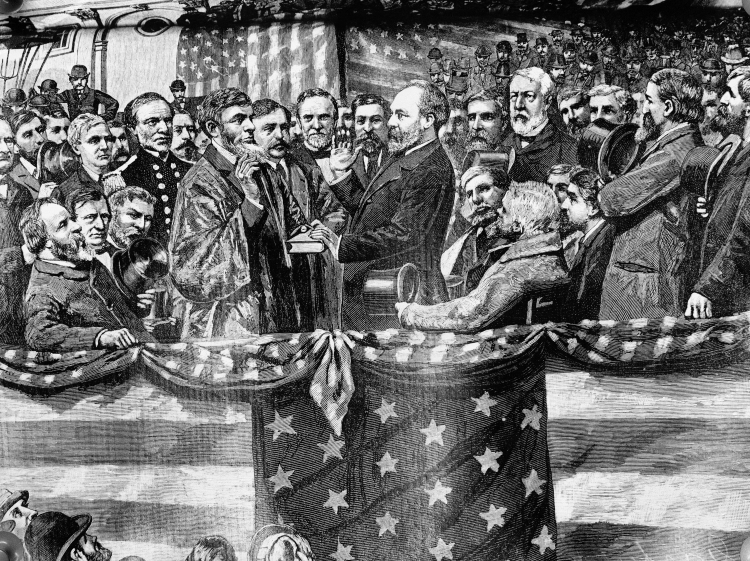
As America prepares to celebrate its 250th birthday, the country is once again revisiting the presidents who shaped the Republic.
Some are remembered for triumph and progress. Others for scandal or national division. Thanks in part to Netflix’s new series, “Death by Lightning,” more Americans are learning about a president who never truly got started.
James Garfield served only 200 days before an assassin’s bullet cut his presidency short in 1881. Today, most Americans remember him, if at all, as one of four presidents killed in office.
That may be one of the great forgotten tragedies in American political history.
Born in a log cabin in Ohio, Garfield’s childhood was marked by hardship. His father died when he was just two years old, leaving his mother to raise the family alone. Largely self-educated, Garfield eventually graduated from Williams College and later studied law.
During the Civil War, Garfield served as a brigadier general, leading troops before running for and winning a Congressional seat in 1862, where he remained until 1880.
Garfield’s rise to the presidency had the makings of a Hollywood script.
Before modern primaries, party nominees were chosen at conventions controlled by party bosses. Garfield arrived at the 1880 Republican convention not as a presidential candidate, but to support his friend and fellow Ohioan, Treasury Secretary John Sherman.
Instead, after 35 ballots that included former President Ulysses S. Grant among leading contenders, delegates unexpectedly rallied behind Garfield on the 36th ballot, making him one of the great “dark horse” nominees in American history.
Though he had only 200 days in office, Garfield laid the groundwork for reforms that would shape future presidencies.
Most notably, Garfield challenged the spoils system that had dominated Washington since the Civil War. For decades, presidents from both parties rewarded loyalists and political operatives with powerful federal jobs regardless of skill or merit. Garfield directly confronted that culture.
In particular, he took on New York Sen. Roscoe Conkling and the powerful patronage machine surrounding the New York Customhouse, one of the most influential centers of political power in the country.
To be fair, Garfield was hardly a perfect reformer. Like many politicians of his era, he still made political appointments, many of whom were friends of Sen. Conkling. But he increasingly recognized that the patronage system was corrupting the American government and stymying the nation's progress.
Therein lies the irony of Garfield’s death: His assassin, Charles Guiteau, believed he was owed a federal position for supporting Garfield during the 1880 election. The president was ultimately struck down by the same political culture he hoped to dismantle.
Beyond his work to dismantle the spoils system, Garfield was a staunch advocate for civil rights.
A staunch Unionist and abolitionist, Garfield believed education was essential to preserving freedom after the Civil War. He supported federal funding for education in the South and elevated Black leaders, including abolitionist Frederick Douglass, to prominent federal positions.
That legacy is often forgotten today, raising the unavoidable question: What might have happened had Garfield been allowed to serve a full term, or even two? Would civil service reform have come sooner? Would the federal government have taken a stronger role in protecting Black voting rights in the South during the post-Reconstruction years?
No one can know for certain. But as America approaches its 250th birthday, Garfield reminds us that history is not shaped only by the leaders who succeeded. Often, it is shaped by leaders who never got the chance.
More than a century later, Garfield is finally beginning to receive some of the recognition he long deserved. Thanks in part to renewed interest generated by “Death by Lightning,” Americans are once again visiting Garfield’s home and tomb in northern Ohio. In Washington, there is now even a historical marker near the site where he was shot at the old Baltimore and Potomac Railroad Station.
For decades, Garfield existed largely as a historical afterthought sandwiched between better-known presidents. But perhaps Americans should remember him for something else: possibility.
Shortly before his assassination, Garfield once remarked, “Assassination can no more be guarded against than death by lightning, and it is best not to worry about either.”
History proved him tragically correct. Still, as America approaches its 250th birthday, it is worth asking whether the country itself might have looked very different had James Garfield been given more than 200 days to lead it.
Read Full Article »