A visitor standing at the intersection of D’Evereux Drive and Liberty Road today would find little reason to linger. Cars pass through the traffic light. Businesses line the road. The sounds are those of any American town going about its day.
Nothing suggests this quiet crossroads was once one of the most consequential sites in the American South.
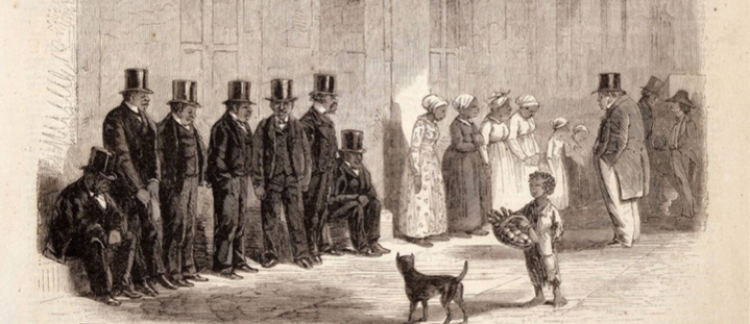
Nearly two centuries ago, thousands of enslaved men, women, and children stood here against their will. Some had been marched hundreds of miles from Virginia, Maryland, Kentucky, and Tennessee. Others had endured weeks or months of uncertainty after being torn from family they would never see again. They arrived at Forks of the Road, where slave traders bought and sold human beings to feed the demand for labor on Mississippi’s and Louisiana’s cotton plantations.
Today, visitors encounter historical markers and open ground where one of America’s largest slave markets once operated. Little remains of the physical landscape that witnessed so much suffering, and the commerce that once defined this crossroads has vanished.
Most histories of Forks of the Road focus on what happened there before the Civil War. Far fewer tell the story of what happened when Union soldiers arrived in Natchez in 1863 and tore down the slave pens. Yet that forgotten ending matters just as much as the market’s notorious beginning.
The slave market did not simply fade away. It was destroyed.
The significance of that destruction extended far beyond Natchez. Historians generally regard Forks of the Road as the second-largest slave trading market in the United States after New Orleans, making its destruction in 1863 one of the most symbolically important acts of emancipation in the South.
Long before it became synonymous with slavery, Forks of the Road was exactly what its name suggested: a crossroads. Roads leading toward Washington, Port Gibson, and the Natchez Trace converged there. Travelers moving between the Mississippi River and the interior South passed through the intersection. Flatboatmen who floated their cargo downriver to Natchez often began the long journey home from this spot. Merchants, settlers, soldiers, gamblers, and preachers all passed through during the early American frontier.
As cotton transformed the Deep South’s economy, the crossroads took on a darker role. The fertile lands surrounding Natchez created enormous demand for labor. Changing agricultural conditions in Virginia, Maryland, Kentucky, and Tennessee produced a supply of enslaved workers that traders could sell farther south. The result was one of the largest forced migrations in American history.
By the 1830s and 1840s, Forks of the Road had become one of the most important slave markets in the nation. Historians generally regard it as second only to New Orleans in volume. Tens of thousands passed through Natchez as cotton production expanded across Mississippi and Louisiana. For many white residents, the trade represented not just an accepted institution but a major source of prosperity. Cotton wealth fueled banks, merchants, transportation networks, and the construction of the grand homes that would later make Natchez famous.
When people arrived in Natchez, many ended up at Forks of the Road.
The market became a bustling center of commerce. Traders maintained offices, holding pens, and sales facilities near the intersection. Prospective buyers inspected human beings as they would livestock. Prices fluctuated based on age, health, skills, and market conditions. Buying and selling people became ordinary business in a city growing wealthy from cotton.
The irony was impossible to miss. West of the crossroads, Natchez’s grand homes rose along the bluff overlooking the Mississippi River. The city’s wealth became famous throughout the nation. Yet that prosperity rested on a steady stream of enslaved labor passing through Forks of the Road. The mansions and the market were two sides of the same coin, whether residents wished to acknowledge it or not.
Then came the Civil War.
As Union forces tightened their grip on the Mississippi River, the economic system sustaining the slave market began to unravel. Transportation became difficult, buyers disappeared, and Southern fortunes declined. The market that once thrived at the crossroads entered a period of uncertainty.
Everything changed in summer 1863.
On July 4, 1863, after forty-seven days of siege and bombardment, Confederate General John C. Pemberton surrendered Vicksburg to Union General Ulysses S. Grant. With the city’s fall, the Union gained control of the Mississippi River, cutting the Confederacy in half and delivering one of the war’s decisive turning points. Nine days later, Union troops occupied Natchez.
Unlike many Southern towns, Natchez escaped large-scale destruction. No major battles raged through its streets, and the city surrendered without the devastation that ravaged other communities. Yet the arrival of Federal troops marked the beginning of a revolution as profound as any battlefield victory.
For white residents, occupation brought uncertainty and humiliation. For enslaved people, it brought hope.
Word of Union victories traveled quickly through enslaved communities across the South. News moved from plantation to plantation through conversations, rumors, church gatherings, and personal networks. By the time Federal troops entered Natchez, many enslaved people already knew the old order was crumbling.
Some left plantations immediately and sought refuge behind Union lines. Others waited cautiously, unsure what freedom might mean or whether it would last. Families that had spent generations under slavery suddenly confronted possibilities that had once seemed unimaginable.
As emancipation spread through the region, Forks of the Road's days were numbered.
Contemporary accounts indicate Union soldiers dismantled structures associated with the slave market after occupying Natchez. In the fall of 1863, soldiers of the 12th Wisconsin Infantry and the newly organized 58th U.S. Colored Troops reportedly received orders to tear down the slave pens at Forks of the Road.
According to a letter later published in the Milwaukee Sentinel, the order was greeted with “the wildest enthusiasm.” Through the darkness, soldiers attacked the buildings with axes, crowbars, and hammers. Boards splintered, walls collapsed, and timbers that had confined enslaved people for decades crashed into heaps of rubble. Black soldiers, many with personal connections to slavery and the slave trade, worked alongside white Union troops in destroying a marketplace that had treated human beings as property.
The Sentinel emphasized the symbolic importance of the moment, noting how eagerly the Black troops worked to erase a place where thousands had been bought and sold. Their actions transformed the end of slavery in Natchez from an abstract legal change into a visible and undeniable reality.
The symbolism wouldn't have been lost on anyone who witnessed it.
For years, those pens had represented the power of slave traders and the permanence of the institution they served. Thousands had passed through their gates. Countless families had been torn apart because of transactions conducted there. The structures themselves had become physical embodiments of slavery. Now, they were being destroyed.
Particularly striking was the role Black soldiers played. Many had escaped slavery themselves or had family members who remained enslaved. Others joined the Union Army specifically because they saw military service as part of a broader struggle for freedom. The sight of Black troops helping dismantle a slave market would have been unimaginable just a few years earlier.
Freedom, however, proved more complicated than victory celebrations and symbolic acts.
Destroying the slave pens didn't end the struggle. For thousands of newly freed people around Natchez, it was only the beginning. Families separated by the domestic slave trade searched desperately for one another. Men who had labored under overseers now sought paid work and control over their futures. Women worked to reunite households shattered by decades of sales and forced migration. Throughout the region, Black churches, schools, and mutual aid societies began appearing, laying foundations for communities that would endure long after the war.
Refugee camps emerged around Union positions. Missionaries arrived to provide education and assistance. Formerly enslaved men enlisted in the Union Army. Freedom offered opportunities, but also brought uncertainty and hardship.
As years passed, the slave market itself faded from view.
Natchez became known for its architectural heritage. Tourists arrived to admire Stanton Hall, Rosalie, Longwood, and other landmarks. Pilgrimage tours celebrated the city's beauty and elegance. The memory of Forks of the Road survived, though largely in the background.
For generations, many visitors to Natchez knew little about the crossroads where so many lives had been bought and sold. As the city expanded, the site blended into the surrounding landscape, and physical reminders gradually vanished.
In recent decades, historians, archaeologists, preservationists, and community leaders have worked to recover the history lost over time. Research has revealed the enormous scale of the domestic slave trade that passed through Natchez. Archaeological investigations have helped identify features associated with the site. Public interpretation now ensures future generations understand both the significance of Forks of the Road and the human stories connected to it.
Today, visitors standing at Forks of the Road see little evidence of the vast marketplace that once occupied this ground. Time, development, and changing priorities have erased most traces of the structures, leaving memory and historical interpretation to carry the story forward.
Recognition of the site's importance has grown in recent decades. In 2021, the site became part of Natchez National Historical Park, ensuring that both the history of the domestic slave trade and the story of emancipation receive permanent interpretation.
Read Full Article »