Modern military planners warn of conflict in the unforgiving, claustrophobic environments of the world's cities. The contemporary defense community parses the lessons of urban siege warfare, looking to recent battlefields for insights into how decentralized units navigate dense subterranean and structural mazes. Yet the challenge of urban operations is far from a 21st-century novelty. Military organizations have long faced a structural crisis when rigid, open-terrain doctrines collide with the realities of fortified cities.
In September 1846, Gen. Zachary Taylor’s army confronted this exact tactical dilemma when it attacked Monterrey, Mexico. Driven by the geopolitical currents of Manifest Destiny and continental expansionism, President James K. Polk dispatched Taylor into Mexico to defeat the Mexican Army, secure Texas, and compel the purchase of California and New Mexico.
What followed at Monterrey was not a textbook exercise in contemporary military science, but an enduring example of how tactical improvisation, collaborative planning, and decentralized leadership can overcome institutional unreadiness.
The Prison of Open-Field Doctrine
When Taylor marched south from the Rio Grande in August 1846 with roughly six thousand men – split evenly between regulars and volunteers – he commanded an army completely unequipped for the task ahead. The standard military literature of the era, most notably Winfield Scott's Infantry Tactics and the regulatory frameworks compiled by Samuel Cooper and Alexander Macomb, was entirely linear.
These manuals focused on rigid company and battalion drills designed to mass fire across open terrain. They offered no guidance on clearing rooms, traversing urban streets, or attacking enemy formations defending complex urban obstacles.
Compounding this doctrinal vacuum was a fragile institutional structure. Taylor’s army suffered from severe logistical deficiencies along the march, which forced reliance on localized foraging. Furthermore, Taylor’s personal correspondence reveals a deep-seated distrust of volunteer officers, whom he viewed as politically motivated amateurs – except for his former son-in-law, Jefferson Davis.
As the American forces approached Monterrey, which occupied a vital road junction controlling access to Mexico's northern interior, Taylor doubted whether the Mexican army would risk a major engagement. However, Gen. Antonio López de Santa Anna's return from exile re-energized the Mexican army, who turned Monterrey into a daunting fortification.
Regular army engineers and Texas Ranger scouts conducted extensive reconnaissance which revealed that Gen. Pedro de Ampudia converted the city into a fortress. Deep ditches and stone walls protected heavy cannon outposts on Monterrey’s exterior, creating mutually supporting strongpoints that Taylor could not easily bypass. Accurate artillery fire effectively swept the wide, open northern approaches, while high mountain ridges with additional outposts dominated the southern and western flanks. Taylor had never encountered an enemy positioned in such a formidable defense, and Army doctrine contained no solutions.
Collaborative Planning and Strategic Intent
Faced with this challenge, Taylor eschewed rigid formulas in favor of a collaborative approach that leveraged his subordinate commanders’ collective skills. Following a council of war on September 19, Taylor issued clear intent and approved a two-pronged plan of attack that departed sharply from conventional frontal assaults.
Instead of massing his forces for a singular push, Taylor ordered Gen. William Worth’s division to execute a wide, seven-mile flanking maneuver to the west. Worth's critical task was to sever the Saltillo Road, Monterrey's primary line of communication and logistics to the Mexican interior. Recognizing the danger of leaving Worth isolated, Taylor agreed to Worth’s suggestion to launch a simultaneous demonstration on the eastern side of the city to pin down Mexican defenders and prevent them from reinforcing the western heights.
Maneuvering an entire division independently across complex terrain while a secondary force created a diversion was a sophisticated undertaking for the 19th-century U.S. Army. Rather than micromanaging the operation from his headquarters, Taylor chose a command style defined by high battlefield awareness and minimal interference. This gave his division commanders wide latitude to achieve their specified objectives within his broader intent.
Empowered Execution on the Flanks
The operational value of Taylor’s decentralized style became immediately apparent when full-scale combat commenced on September 21. On the eastern side of the city, an initial assault by the 4th Infantry Regiment ran into intense fire, suffering heavy casualties and forcing a temporary withdrawal. Yet this costly push succeeded in its broader intent: it held Ampudia’s attention in the east, preventing him from accurately assessing the threat on his western flank.
Meanwhile, on Monterrey’s west side, Worth’s division operated entirely cut off from direct communication with Taylor’s main headquarters. Separated by miles of rocky, mountainous terrain that muffled the sound of gunfire and masked the smoke of black powder, real-time coordination was impossible. In this communications vacuum, success depended entirely on empowered execution at the tactical edge.
Taylor deliberately waited until the distant echoes of combat confirmed Worth was engaged before committing Gen. William Butler’s division to resume supporting attacks from the east. Worth systematically reduced the exterior fortifications on the heights, utilizing the unique scouting capabilities of the Texas volunteers to repel Mexican cavalry sorties.
Displaying remarkable resourcefulness, Worth's men turned captured Mexican artillery pieces against adjacent enemy forts to provide immediate overwatch for their advancing comrades. By midday September 22, Worth's division successfully stormed the Bishop’s Palace, secured high ground to the west, and pivoted towards the city's interior.
This initiative was replicated across the entire battlefield. When immediate tactical opportunities materialized, regimental commanders acted without waiting for explicit authorization from regular army headquarters.
A prime example occurred when Jefferson Davis and his Mississippi Rifles launched an aggressive, headlong charge alongside regular infantry units to capture Fort Diablo on the eastern perimeter. This rapid momentum kept Ampudia’s forces off-balance, preventing the Mexican commander from executing effective counterattacks.
The Innovation of the Mousehole
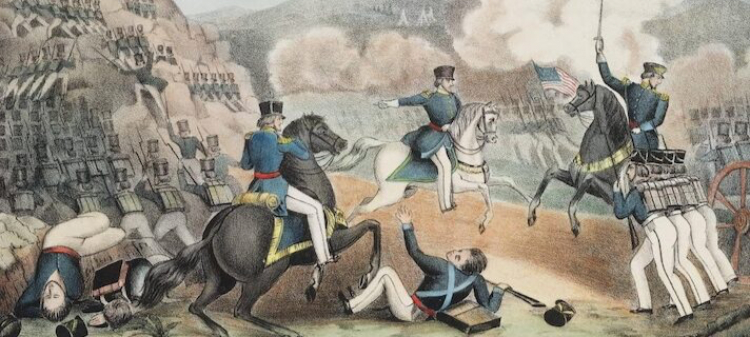
The defining moment of tactical adaptation occurred on September 22 and into September 23, as American forces breached Monterrey's urban core. Mexican defenders fought from a network of obstacles and fighting positions in the city's residential and commercial centers. They barricaded the streets, sighted heavy artillery down narrow avenues, and positioned infantry on flat rooftops to provide fire on the streets.
Taylor’s soldiers quickly realized that advancing down the linear street in a column would result in slaughter. Without any guidance or pre-existing institutional blueprints, small-unit leaders and individual soldiers improvised a solution that revolutionized their approach to the environment.
Using pickaxes, crowbars, and axes, the troops advanced house-to-house by smashing directly through the interior stone and adobe walls of adjacent structures. This improvised method of "mouseholing" allowed the Americans to move forward through entire city blocks while remaining protected from the withering fire raking the streets. Once inside a block, soldiers cleared the rooms, climbed to the flat roofs, and leaped across rooftops to suppress Mexican positions.
By the afternoon of September 23, this relentless penetration destroyed the outer Mexican defensive ring. Worth’s men advanced within a single block of the central plaza from the west, while eastern columns held commanding positions overwatching the city's core.
With the Mississippi Rifles turning captured artillery pieces directly onto the main plaza and the central cathedral, Ampudia’s concentrated forces were surrounded. Recognizing that his position was untenable, Ampudia dispatched messengers under a white flag on the morning of September 24 to request a ceasefire.
The Perils of Strategic Disconnect
While the Battle of Monterrey is a brilliant example of local tactical adaptation, it also serves as a stark historical reminder of the friction that can occur between decentralized combat execution, strategy, and policy. To President Polk’s deep dissatisfaction, Taylor agreed to a capitulation that granted Ampudia an eight-week armistice and permitted the Mexican army to retreat with their personal weapons and six pieces of artillery.
Taylor reasoned that his army was short on supplies, exhausted from days of continuous combat, and still outnumbered by a Mexican force that was barricaded in the cathedral. Both Taylor and Ampudia were also aware of Santa Anna’s re-emergence and anticipated that this operational pause would pave the way for immediate diplomatic negotiations.
However, Taylor’s localized terms failed to align with Polk’s broader objective of rapid territorial concessions. Polk promptly overruled the armistice once word reached Washington, but by then Ampudia’s forces had safely reconstituted to the south.
Despite this disconnect, Monterrey cemented Taylor’s reputation as a national hero. His political fortunes were ultimately propelled by a battlefield triumph achieved not through a rigid adherence to doctrine, but through the flexibility of an army that innovated its way to victory at Monterrey.
For modern strategists, the campaign remains a compelling case study demonstrating that while empowered execution and tactical innovation can dismantle the most formidable physical defenses, they must also remain tethered to the national policy.
Read Full Article »