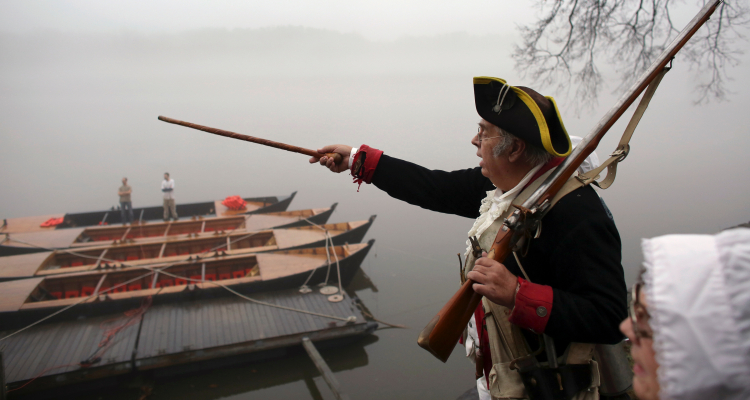
The birth of the United States is often taught as a neat sequence of political philosophies, iron-willed generals, and decisive musket volleys. But look closer at the faded journals of the men who stood in those frozen mud trenches or watched their capital burn, and a different pattern emerges. They spoke constantly of "Special Providence” – bizarre, hyper-localized weather anomalies that tore through the landscape at the exact moment all hope seemed lost.
To modern military historians, these turning points represent extreme tactical luck or rare meteorological coincidences. But to the shivering soldiers who lived through them, it felt as though the cosmos itself had leaned down to alter the course of history.
The Blanket of Brooklyn
In the sweltering August of 1776, the American Revolution was only eight weeks old, and it was already on the verge of being permanently extinguished. General George Washington had marched his raw, inexperienced Continental Army into a catastrophic trap on the heights of Brooklyn.
Outmaneuvered and bloodied by a massive force of twenty thousand British and Hessian troops under General William Howe, nine thousand American soldiers found themselves pinned against the banks of the East River. The water behind them was more than a mile wide. Waiting just downstream was the formidable British Royal Navy, ready to sail upriver on the first favorable breeze to cut off any chance of escape. If Howe ordered a final infantry assault the next morning, or if the ships blocked the river, the entire rebellion would be crushed in a single afternoon.
As night fell on August 29, Washington made a desperate, unannounced gamble. He ordered a total nighttime evacuation across the open, churning water to Manhattan. He gathered a makeshift flotilla of skiffs, flat-bottomed barges, and rowboats, manned by a regiment of rugged Massachusetts fishermen.
At first, nature fought them. A fierce northeast wind and an adverse southern tide pushed the small boats downstream, threatening to drag them straight toward the British warships
Then, around eleven o’clock, the wind did something entirely inexplicable: it completely reversed, blowing gently from the southwest, allowing the sailboats to rapidly ferry troops across the dark river.
Yet, despite the sudden help from the wind, the sheer volume of men and heavy artillery meant the operation ran dangerously behind schedule. As the first pale light of dawn crept into the sky at 4:30 AM, thousands of American soldiers were still stranded on the Brooklyn shoreline, completely visible to the British sentries just a few hundred yards away. Discovery meant absolute slaughter.
Just as the sun began to rise, a dense, unseasonably thick blanket of fog rolled off the water, enveloping the East River and the Brooklyn shore. Strangely, the fog terminated abruptly in the middle of the river, leaving the Manhattan landing zones perfectly clear.
Under cover of this eerie, protective veil, the boats kept moving undetected long into the morning. By seven o’clock, the fog finally dissolved. When the astonished British forces advanced to storm the American fortifications, they found nothing but an empty shore.
The Blinding Storm at Trenton
By December of that same year, the high spirits of summer were a distant memory. The Continental Army had been chased out of New York, hunted across New Jersey, and reduced to a freezing, rag clad remnant. Facing mass enlistment expirations at the stroke of midnight on New Year’s Eve, Washington knew he needed a miracle to keep the cause alive. He risked everything on a surprise winter assault against the elite Hessian garrison at Trenton.
On Christmas night, the weather turned brutal. A sudden, violent "nor'easter" slammed into the Delaware River. The temperature plummeted, and a fierce wind pelted the men with a blinding mixture of rain, sleet, and heavy snow. Jagged, heavy cakes of ice choked the river, smashing against the wooden hulls of American boats.
Washington’s column of twenty-four hundred men pressed on, but the ice delayed their landing by over three hours. The crucial element of surprise – dependent on a pre-dawn attack – was completely shattered. They would be marching in broad daylight.
But as the Americans trudged through the snow toward Trenton, the roaring storm became their greatest ally. The freezing sleet blew directly into the faces of the Hessian guards. Believing that no army could possibly march, let alone maintain operational cohesion in such a horrific tempest, the Hessian commander relaxed his patrols and failed to post forward scouts.
The thick accumulation of snow muffled the sound of the marching boots and the rumbling iron wheels of the American artillery. Furthermore, the torrential mix of snow and rain thoroughly drenched the weapons of both sides. When the alarm was finally raised, the Hessian soldiers found that their gunpowder priming charges were wet, preventing their flintlock muskets from striking a spark.
The Americans, relying on dry artillery charges and immediate, aggressive bayonet charges, overran the garrison within an hour, capturing nearly nine hundred prisoners and breathing life back into the dying revolution.
The Tempest That Saved the Capital
Nearly forty years later, during the War of 1812, the young republic faced another existential threat. On August 24, 1814, a battle-hardened British force of forty-five hundred veterans routed a disorganized American militia and marched unopposed into Washington, D.C.
Seeking to break the spirit of the American public, British troops systematically set fire to the nation's symbolic heart. By noon on August 25, the U.S. Capitol, the Presidential Mansion, the Treasury, and the War Office were all engulfed in roaring flames. The entire city was on track to be reduced to ash.
Then, the sky darkened.
Early in the afternoon, an unprecedented convective superstorm slammed into downtown Washington. The storm grew so violent that it spawned a massive tornado, which ripped directly through the center of the city.
The sheer physical power of the weather was terrifying. The screaming winds tore the heavy roofs off brick buildings and uprooted ancient trees. British soldiers, seasoned veterans of the Napoleonic Wars, were thrown to the ground in panic; the winds were strong enough to lift light artillery pieces and hurl them through the air.
Following the wind came a historic, torrential cloudburst. A massive volume of water dumped out of the sky over a two-hour period, effectively drowning the intense fires that were devouring the Capitol and the White House. More British soldiers were killed and injured by the flying structural debris and collapsing buildings caused by the tornado than by the American military resistance during the entire invasion.
The sudden, catastrophic devastation completely shattered the British occupation's morale and logistics. Left exposed in a ruined, waterlogged city with their communications broken, the British high command ordered a silent, rapid retreat to their naval fleet under the cover of the receding storm that very night.
The Veil of New Orleans
The final great land battle of the War of 1812 took place in January 1815, on the muddy grounds of the Chalmette Plantation just south of New Orleans. General Andrew Jackson stood behind a crudely constructed earthen rampart with a highly unorthodox army of four thousand men—a mixture of regular infantry, local militia, free men of color, Choctaw warriors, and Jean Laffite’s pirates. Marching across the open sugar cane fields toward them were eight thousand elite British veterans, fresh from victories over Napoleon.
On the morning of January 8, the British commander ordered a massive, pre-dawn frontal assault. As the red coated regiments deployed into their columns, a heavy, blinding fog rolled off the Mississippi River, completely blanketing the battlefield.
This dense mist acted as a tactical shield for the British, hiding the advancing columns from the sights of Jackson’s formidable artillery and expert riflemen. Had the fog remained, the British would have reached the base of the American mud walls entirely unseen, forcing a hand-to-hand brawl where their superior numbers and bayonet training would have easily carried the day.
The British columns marched closer and closer, completely invisible in the grey gloom. Then, precisely as the main columns entered the highly vulnerable, wide-open killing zone within a few hundred yards of the American ramparts, the sun broke through the horizon.
In a matter of minutes, the river fog didn't just drift away, it dissolved completely.
The sudden clearing left the British soldiers utterly exposed in the middle of a barren field with absolutely no cover. Jackson’s lines immediately unleashed a shattering, continuous wall of fire. Within a brief thirty-minute window, the British advance was completely decimated, and their commanding generals were killed in the open field.
Whether these moments are analyzed as an incredible sequence of atmospheric luck or as the literal hand of God intervening to save a young country, one truth remains: the map of the United States was decided not just by the grand strategies of men, but by the unpredictable weather itself.
Read Full Article »