On paper, military engagements often seem dictated by raw numbers: the size of a fleet, the count of infantry divisions, or the caliber of heavy artillery. Military strategists frequently rely on quantitative ratios to predict outcomes, such as requiring a three-to-one numerical advantage to assault a fortified position. Yet across American history, several critical battles shattered these mathematical calculations. In these moments, small or heavily disadvantaged American forces faced imminent destruction, only to turn guaranteed defeats into historic victories through clever tactics, field engineering, signal intelligence, and unwavering discipline under fire.
Inland Waterways in the War of 1812
During the War of 1812, controlling North America's inland lakes was essential for securing supply routes and defending territorial borders. In September 1813, Master Commandant Oliver Hazard Perry led a newly built American squadron of nine vessels against six British Royal Navy ships commanded by Captain Robert Heriot Barclay at the Battle of Lake Erie.
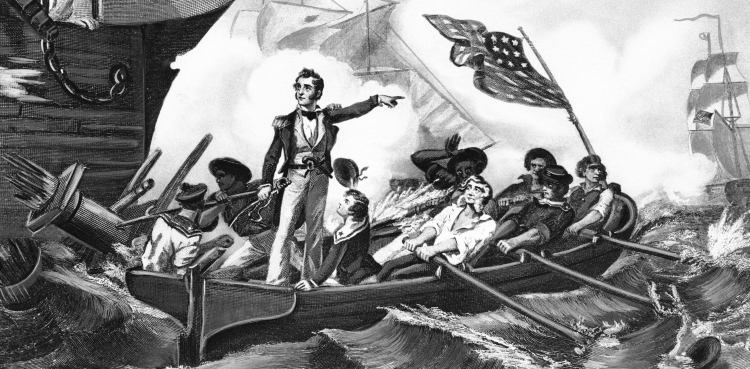
The battle began disastrously for the Americans. Adverse wind conditions trapped Perry’s flagship, the USS Lawrence, within range of heavy British long guns before the lighter American carronades could reach effective firing distance. Barclay’s fleet concentrated its fire on the Lawrence, systematically dismantling the ship until eighty percent of its crew was killed or wounded and every engaged cannon was wrecked. Instead of surrendering, Perry made a daring operational decision. Under continuous heavy artillery fire, he boarded a small wooden rowboat and rowed a half mile across open water to take command of the unengaged sister brig, the USS Niagara.
Perry immediately realigned his tactical formation to catch the wind and sailed the Niagara directly through the middle of the British line. Firing double-shotted broadsides from both sides of his vessel into the damaged British warships at point-blank range, Perry crippled Barclay’s primary ships within fifteen minutes. The entire British squadron surrendered—the first time in history an entire Royal Navy squadron was captured intact.
Exactly one year later, on September 11, 1814, another American naval force faced severe odds at the Battle of Plattsburgh on Lake Champlain. A British invasion force of over ten thousand Napoleonic War veterans under Sir George Prévost marched south from Canada into New York, supported by a heavy naval squadron led by the thirty-six-gun frigate HMS Confiance. Defending Plattsburgh was Brigadier General Alexander Macomb with roughly thirty-four hundred American regulars and local militia, supported on the lake by Master Commandant Thomas Macdonough’s four ships and ten small gunboats.
Recognizing that his fleet was severely outgunned in open water, Macdonough anchored his ships inside Plattsburgh Bay, forcing the British vessels to round Cumberland Head single-file into a narrow channel. To prepare, Macdonough installed maneuver lines—called spring lines—to the anchor cables of his flagship, the USS Saratoga. When broadsides from the Confiance disabled every cannon on the Saratoga’s starboard side, Macdonough’s crew hauled on the spring lines, slowly rotating the anchored warship three hundred and sixty degrees. This maneuver brought a completely fresh port battery to bear on the British flagship. The Confiance surrendered, depriving Prévost’s army of its naval support and forcing an immediate retreat to Canada.
Turning the Tide: Intelligence, Audacity, and the Fight for the Pacific
By June 1942, six months after Pearl Harbor, the Imperial Japanese Navy possessed overwhelming naval superiority in the Pacific. Seeking to destroy the remaining American aircraft carriers, Admiral Isoroku Yamamoto deployed four fleet carriers—Akagi, Kaga, Soryu, and Hiryu—backed by a massive battlefleet at the Battle of Midway.
American Admiral Chester W. Nimitz could muster only three carriers: the USS Enterprise, the USS Hornet, and the USS Yorktown, which had been hastily patched together in forty-eight hours at Pearl Harbor following heavy damage at the Coral Sea. The decisive factor was signal intelligence. Cryptanalysts at Station HYPO in Pearl Harbor, led by Commander Joseph Rochefort, had broken the Japanese naval code, JN-25. To confirm the target of the upcoming Japanese strike, code-named "AF," American operators transmitted a fake, unencrypted radio message stating that Midway’s water distillation plant was broken. When Japanese interceptors relayed that "AF is low on water," Nimitz had indisputable proof of the attack plan.
Nimitz set an ambush, positioning his carriers northeast of Midway at "Point Luck." On the morning of June 4, low-level attacks by American torpedo bombers were decimated, failing to score a single hit. However, these desperate strikes forced Japanese Zero fighters down to sea level and delayed Japanese deck crews from launching their next strike. At 10:22 AM, SBD Dauntless dive bombers caught the Japanese carriers with flight decks packed with re-arming aircraft, exposed fuel lines, and live munitions. In minutes, Akagi, Kaga, and Soryu were ablaze; Hiryu was struck later that afternoon. Japan lost all four fleet carriers, permanently halting its eastward expansion across the Pacific.
Two years later, on October 25, 1944, American forces faced extreme tactical vulnerability during the Battle off Samar. Vice Admiral Takeo Kurita’s Center Force—comprising four battleships (including the seventy-two-thousand-ton Yamato), six heavy cruisers, two light cruisers, and eleven destroyers—ambushed an unarmored American support unit designated "Taffy 3." Led by Rear Admiral Clifton Sprague, Taffy 3 possessed only six slow escort carriers, three destroyers, and four light destroyer escorts.
Sprague ordered his carriers to flee into nearby rain squalls while launching every available aircraft, many making dummy bombing runs without ammunition. Simultaneously, Commander Ernest Evans of the destroyer USS Johnstonturned his vessel around and charged the massive Japanese fleet alone, firing torpedoes and over two hundred five-inch shells before being sunk. Inspired by Evans' initiative, the remaining escorts—the USS Hoel, USS Heermann, and USS Samuel B. Roberts—joined the charge. The fierce resistance from Taffy 3's light escorts, combined with persistent air attacks, led Kurita to miscalculate, believing he was engaging main fleet carriers. Kurita broke off the attack and retreated, preserving the Allied landing forces at Leyte.
Cold Weather, Frozen Lines: Tactical Survival Under Siege
In December 1944, German forces launched a major surprise offensive through the dense Ardennes forest, aiming to split the Allied armies and capture the key port of Antwerp. At the center of the regional road network sat the Belgian town of Bastogne. By December 20, the Siege of Bastogne was underway as the U.S. 101st Airborne Division and elements of the 10th Armored Division were completely encircled by the German 5th Panzer Army under General Hasso von Manteuffel.
The surrounded American troops faced severe shortages of winter clothing, medical supplies, and anti-tank ammunition, while heavy fog grounded Allied air support. On December 22, when the German commander sent a formal written demand for surrender, Brigadier General Anthony McAuliffe issued his famous single-word response: "Nuts!" The American garrison maintained a tight perimeter through constant artillery bombardments and multi-axis armor assaults. On December 23, the weather cleared, allowing C-47 transport planes to drop precise aerial resupplies directly into their pocket. On December 26, spearheads from Lieutenant General George S. Patton’s Third Army broke through from the south, relieving the town and crippling the German offensive timetable.
Less than six years later, American ground forces faced even harsher conditions during the Korean War. In November 1950, at the Battle of Chosin Reservoir, thirty thousand UN troops—led by Major General Oliver P. Smith’s 1st Marine Division alongside elements of the U.S. Army's 7th Infantry Division—advanced into the freezing mountains of North Korea. Unbeknownst to UN command, the Chinese 9th Army Corps, totaling approximately one hundred and twenty thousand soldiers, had secretly crossed the Yalu River and encircled the UN forces.
Temperatures plummeted to minus thirty degrees Fahrenheit (-34°C), causing weapons to jam, engine oil to freeze, and blood plasma to solidify. Rather than surrendering or fragmenting, General Smith directed a disciplined, seventy-eight-mile fighting breakout along a narrow, icy mountain road toward the port of Hungnam. Supported by close air strikes and critical air-drops—including prefabricated steel bridge spans dropped by C-119 aircraft to cross an impassable gorge at Funchilin Pass—the force-maintained unit cohesion. The UN forces successfully evacuated their wounded, equipment, and vehicles while inflicting roughly thirty thousand casualties on the Chinese force, disabling the Chinese 9th Army Corps for months.
Outnumbered, Never Outmatched
Across these six historical battles, victory against overwhelming numbers was never accidental. It relied on a consistent combination of human factors: leveraging signal intelligence to strip away surprise, utilizing field engineering to reshape the tactical environment, trusting subordinate commanders to take aggressive initiative, and maintaining strict unit discipline when surrounded. Each engagement stands as a documented historical instance where operational execution and tactical resolve systematically dismantled vast numerical odds.
Read Full Article »