Ramses II and His Cult of Personality
The cult of personality: a quippy term to describe how a strongman cultivates his followers to see him as powerful, knowledgeable, and protective. Such rulers and their techniques are as old as recorded history – among the oldest of is Ramses II, who ruled as the pharaoh of Egypt for 66 years, 1279-1213 B.C.
Ramses' rule as pharaoh was marked by military campaigns along Egypt's borders. His earliest success was to defeat pirates that had been attacking ships along Egypt's Mediterranean coast. Later in his rule, he conducted successful military campaigns to control Egypt's southern and eastern borders. Much of his reign was spent fighting the Hittite Empire over control of Canaan, what is today modern Israel, Lebanon, Jordan, and Syria.
In the fifth year of his reign, he led an army of 20,000 to attack the Hittite fortress at Kadesh, located on the Orontes River on what is today's border between northern Lebanon and southern Syria. The year before, he had conducted a successful campaign to ensure Egyptian control of the area to the south of the Orontes River as preparation for his assault on Kadesh. The Hittite army was twice the size of the Egyptian force. At the beginning of the campaign, Ramses was misled by planted Hittite soldiers who told Ramses that the Hittite army was some distance away, a false statement which Ramses believed. Unprepared to meet a large Hittite force, the Egyptian army fell to defeat initially. Ramses, however, was able to preserve his army and subsequently defeated the Hittites, who retreated to Kadesh. In the end, Ramses was unable to take Kadesh and ultimately withdrew to Egypt. Eventually, Egypt and the Hittite empire agreed to a peace treaty in 1258 B.C. The treaty recognized Egypt's control over much of Canaan and Hittite control over the rest of the region, what is today central and northern Syria. Importantly, Kadesh remained in Hittite control.
Ramses was not only a skilled military commander, but a prolific builder. Throughout his reign, he commissioned numerous projects using existing works as well as new buildings. Projects included many large statues of Ramses. Existing temples were changed to show Ramses' power and divinity. He built two major temples and a new capital city.
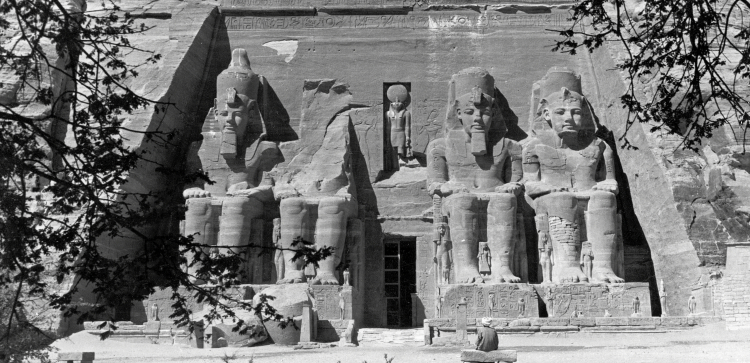
The two major temples were at Abu Simbel on Egypt's southern border, carved from sandstone on the Nile's western bank. The larger of the temples featured four sandstone statues of Ramses, each standing about 65 feet high at the temple's entrance. At the feet of the statues were carved figures of his children and wives. These statues were small in comparison to the seated Ramses, standing no higher than halfway up Ramses' legs. Inside the temple were painted scenes depicting Ramses' victory over the Hittites at the battle of Kadesh. In one scene, Ramses is an archer in a chariot. In another, he has just subdued a Hittite warrior as he attacks another in hand-to-hand combat. In the innermost temple room, the temple's sanctuary, a statue of Ramses is seated as a god together with three other statues of Egyptian gods.
The smaller of the two temples featured Ramses and his favorite wife, Nefertari. At the temple's entrance are statues of Ramses and Nefertari, carved from sandstone and each about 35 feet high.
Ramses built his new capital on Egypt's eastern border near the Nile delta in northern Egypt. It was built in Ramses' fourth year as pharaoh and served as staging area for his military campaigns against the Hittite empire. This new capital was named Pi-Ramesses and had large temples, a palace, and a 56-foot high statue of Ramses. One of the new temples was named Ramesseum. The capital's full name as translated was domain of Ramses, great in victory.
Ramses' building activity included projects at Thebes, Memphis, Luxor, and Abydos. The temple at Luxor included a standing statue of Ramses. At the statue's base were scenes of Ramses' victory at Kadesh. The Luxor temple featured a statue of a seated Ramses. A painting found at Memphis shows Ramses holding three enemy captives by their hair. Ramses is twice the size of the captives.
Ramses also declared himself a god during his lifetime, a rare occurrence among Egyptian pharaohs who were usually declared a god only after their death.
What motivates rulers, such as Ramses II, to construction that celebrates their rule? Psychology identifies at least two motivations, self-esteem and narcissism. Self-esteem is the need for people to regard themselves as good and capable. Narcissism, on the other hand, is the need to be appreciated and admired. In extreme cases, it is a personality disorder variously characterized by self-importance and belief in competence and superiority not grounded in reality.
Most people, if not all, need to be seen as successful in their work and in relationships with other people – to be held in high esteem. Ramses, as pharaoh, would have seen these needs in terms of what he believed was expected of Egypt's supreme leader, responsible for Egyptian success in taking care of the people of Egypt and defeating its enemies. He would have compared himself to past pharaohs and perhaps to imagine himself as a god. His program of construction was huge by comparison to other rulers, not just in Egypt, but in history. And, he emphasized his role by including huge statues of himself in his many projects.
Was Rames a narcissist? We don't know. There's not enough information. But if he expected to be worshipped as a god, that would qualify as a trait of extreme narcissism.
Did Ramses distort reality? As to Ramses' claim to military success, his claims were largely accurate and thus, for the most part, did not distort reality. He defeated the pirates and secured Egypt's eastern and southern borders. On the eastern border and beyond, he was also successful in securing Egyptian control over much of Canaan.
Ramses II illustrates a strongman ruler who used a cult of personality to construct numerous projects throughout his domain to celebrate himself as powerful and successful, especially in defeating Egypt's enemies.