The Capitol’s Reminder of Our Lawgiving Ancestors
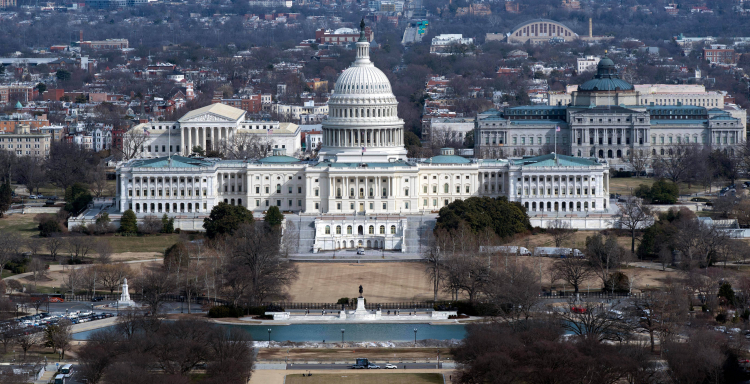
A few days ago, the President closed the longest state of the union on record with a moment of historical introspection. Referencing the two centenarians he featured in the address, Trump pointed out that, from the signers of the Declaration to today, the country is only as old as three lengthy lifespans. His speech contained a number of historical references, but the most important was his recurring tie-in to the 250-year anniversary of American independence. Trump was right that two and a half centuries is a brief span in the annals of world history, a fact which should encourage us with what America has achieved in so short a time and yet also keep us humble about our place in human history. In fact, the very room in which Trump delivered his address tells the remarkable story of human law that inspired the American experiment.
What Does the U. S. House Chamber Tell Us about the Origins of U. S. Law?
If you watched the state of the union, did you see the historical tale strewn across the walls?
I remember first noticing it when I spent a summer interning in the capital. After my internship wrapped up, I took my final hours to cram in any sightseeing that I’d missed. It was August 2001, and I did something that would not be possible a month later. In my final hours I walked up the Capitol steps, briefly passed through security, and wandered throughout the Capitol building for hours. I filled out some paperwork and gained a pass to the House Chamber where I remember sitting for a while, soaking in the legislative splendor of the room. I noticed a series of circular reliefs and began looking at the names underneath, wondering what they were supposed to be and making a note to dig deeper.
Fascinated by the heaps of history littered throughout the Capitol, and especially those odd reliefs, I purchased an old book on the art of the Capitol. Flipping through the pages, I found the answer. Above each of the gallery doors is a marble relief portrait that featured a historical lawgiver. The more I investigated, the more I found this series of reliefs in the U.S. House Chamber to be one of the most inspiring artistic and architectural achievements in American monumental building.
The reliefs capture the country’s deference to the history that inspired American independence and constitutionalism. It illustrates that America’s genius stems not from originality, but from how it originally adapted the genius of others. A tour along the gallery gives the keen observer of the House Chamber a glimpse through the history that led to America’s republican project. If you start by looking above the rostrum, you begin with a quote by Daniel Webster:
Let us develop the resources of our land, call forth its powers. Build up its institutions, promote all its great interests and see whether we also in our day and generation may not perform something worthy to be remembered.
The most important word in Webster’s quote is the adverb “also.” Webster – and the team of legislators, administrators, and scholars that commissioned the reliefs in the mid-20th century renovation – began with remembrance. The American commitment to the rule of law and the transparency of justice was inspired by others throughout history. Lawgivers from the past looked down on the aspirations of those who made law in the U. S. Capitol. They set high expectations for their American descendants and dared them to join their company by achieving justice through the rule of law.
So Who Are the Lawgivers on the U. S. House Chamber Walls?
Looking to the immediate right and left of the plaque, you notice the only two American reliefs: Thomas Jefferson and George Mason, chosen for their role in crafting the Declaration of Independence and the Bill of Rights. Moving along each side of the rostrum wall, you’ll find a series of early modern lawgivers. Three Frenchmen follow the Americans: the legal reformer Jean-Baptiste Colbert, the jurist Robert Joseph Pothier, and Napoleon, who drew up a civil code while emperor. The wall then features two legal theorists, the English jurist Blackstone and the diplomat Grotius. The most controversial lawgiver, Suleiman the Magnificent – the sultan who was as great a reformer as he was a conqueror – finds himself sandwiched amidst the medieval lawgivers. His inclusion rankled southern congressmen in particular, but he’s still an apt choice given that his code streamlined Ottoman law and endured for centuries.
The medievals occupy the side walls, from kings like St. Louis, Alfonso X, and Edward I to popes like Innocent III and Gregory I, constitutionalists like Simon de Montfort, and the Jewish expositor of biblical law Maimonides. As the reliefs curl around to the rear wall facing the rostrum, viewers find classical lawgivers. The emperor Justinian and his jurist Tribonian deserve their positions for providing the world’s first complete codification of laws when the former tasked the latter to lead a commission to clean up a millennium of Roman laws and provide a comprehensive, definitive collection. They were building on the works of the earlier Roman jurists Papinian and Gaius.
The final four reliefs along the center of the back wall were four ancient founders: Solon, Lycurgus, Moses, and Hammurabi, respectively of Athens, Sparta, Israel, and Babylon. Solon was one of the “seven sages” of ancient Greece and Lycurgus was probably a legendary amalgamation of lawgivers and social reforms that led to Sparta’s unique regime. Hammurabi, the oldest in the collection, earned his place no doubt because of the impressive stele that had been found half a century before the reliefs were carved. Moses is given pride of place as the only lawgiver with a frontal portrait, directly across from the Webster quote.
Why Do the Lawgivers Matter?
The U.S. House Chamber tells a story about the history of the rule of law and how America should exemplify constitutionalism in the modern age. The story prioritizes America’s Jewish, classical, and Christian forebears. Moses was intentionally placed out of chronological order to grant him the singular frontal portrait. Rome’s commitment to the rule of law looms large with three jurists and an emperor. Justinian’s code shaped the Byzantine empire, but also Europe, where the earliest university professors used it to teach the law, statesmen applied its principles, and kings adapted it for their national codes.
The remarkable diversity of medieval law shows the American reliance on countervailing powers. Popes stand alongside kings because canon law shaped Western society as much as the laws of individual nations. The church provided a check on tyrannical kings, a sanctuary for refugees, and a moral code that it demanded rulers follow. Justice, equality, human dignity, and civic virtue belonged to all, with kings and bishops holding each other to account when they failed in their duty to promote and defend these things. The Jew Maimonides reminded readers of the Hebraic tradition of the prophets, where inspired scholars and orators could challenge unjust systems that had stopped serving the common good.
The early modern lawgivers showcased French and Ottoman codifications, both of which played critical roles in the French and Ottoman empires, but neither of which shaped the American tradition very much. England’s medieval constitutionalist Simon de Montfort and the 18th-century Blackstone were far more important in this regard, for American law was fathered by Britain’s common law tradition, with the founders quoting extensively from Blackstone in their discussions regarding federal and state constitutions. Grotius was the father of international law, a heroic man hunted by tyrannical Calvinist radicals from his own country. He escaped their grasp, and, while serving as a diplomat abroad, harnessed the Jewish, classical, and Christian traditions as he crafted a vision of justice that transcended national boundaries.
This great story of law is filled with good ideas. Most of the reliefs highlight how rulers should not be above the law but exist to promote and defend it. Another ongoing feature is constitutionalism, starting with the Hebraic republic of Moses and the martial republics of Athens, Sparta, and Rome, and then moving through the countervailing institutions of church and state in the medieval world. What all the reliefs have in common is the underlying belief that law has a source and that justice was not merely invented by men. This source of law, described by the Hebrews as the “Father” and the “I am,” by the Greeks as a “Demiurge” or “prime mover,” by the Romans as the Supreme God, and by the medievals as the Trinitarian Father, Son, and Holy Ghost, was adopted by Jefferson and Mason. Jefferson appealed to this source in the Declaration of Independence, whom he identified in four different ways as the “Creator,” “Nature’s God,” “the Supreme Judge of the world,” and “Divine Providence.” Mason proclaimed to the General Court of Virginia that “the laws of nature are the laws of God; whose authority can be superseded by no power on earth.” Their point was that human rulers and their laws will never be perfect, but they should always gain insights from the perfection of the divine and fear its judgment when they turn to tyranny.
The Capitol thus impresses four things upon those who enter its halls to undertake the craft of governing. First, law is a sacred thing, not subject to the whims of men; its particulars will vary across time and space, but its principles belong to all mankind. Second, law makes men free, limiting those who govern so that they may serve those over whom they rule. Third, the best legal systems divide sovereignty, providing checks and balances to prevent tyranny. And finally, the law exists to protect citizens and bind them together for the common good.
America did not invent these concepts, but its founding generation adopted and adapted them in brilliant ways to create the world’s greatest modern republic. The 19th-century builders of the capitol and its 20th-century renovators maintained this commitment. May we not let them diminish in our own lifetimes but, like those who have gone before us, continually aspire to “perform something worthy to be remembered.”