Invasion and Defeat at the Bay of Pigs
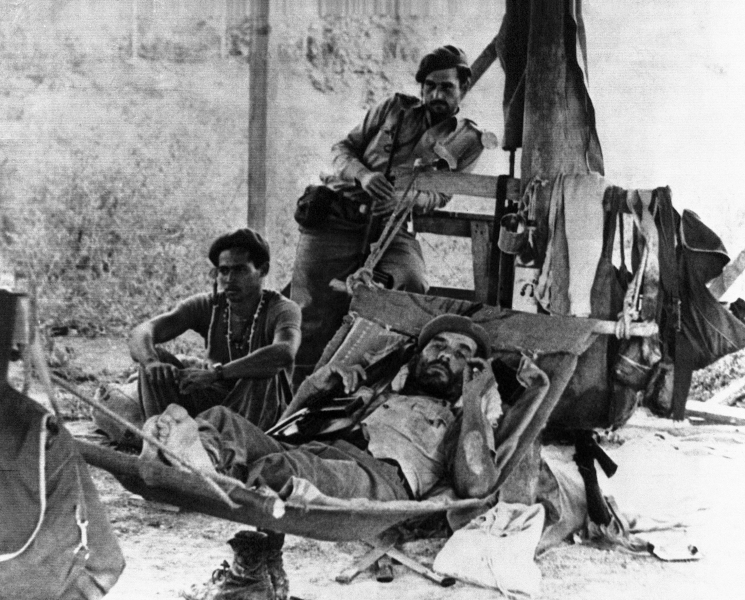
In the early morning hours of April 17, 1961, the 2506 Brigade entered the Bay of Pigs on the southern, swampy, mosquito-infested coast of Las Villas province, and la batalla de Girón (that is, the battle of Playa Girón) commenced in earnest. I will not recount the details of the military operation except to say that the Cuban exiles fought ferociously for three days until they literally ran out of ammunition because supplies and armaments could not be delivered. Suffice to say that since air support was not provided to the landing force, the invasion force was insufficiently prepared to face an overwhelming enemy. On the 40th anniversary of the Bay of Pigs invasion on April 17, 2001, Luis Morse told CNN:
On the first day, we were able to repel all attacks. On the second day, we retreated to a secondary position. And then the ammunition started to go, because Castro’s air force was able to sink the ships that had our ammunition. So by having no air cover, our planes could not land and replenish us.
As the Cuban exiles on the ground were running out of ammunition, Grayston Lynch, a CIA operative who participated in the landing, recounted that he could see two American destroyers on the horizon. From his command post, he frantically called for help. He pleaded for assistance for the Cuban exile patriots, who were being massacred on the beaches and further inland in the swamps because of the lack of ammunition and heavy weapons as well as lack of air and naval assistance and supplies. The captain of one of the destroyers responded, “My heart is with you, but I cannot help you.” He added, “My orders are not to become involved.” Indeed, Arthur Schlesinger, Kennedy’s aide, told CNN:
Kennedy made it clear again and again in the meetings that in no case would American troops be involved. But the CIA and the Cuban exiles, I think, believed that when the time came, he would have no choice but to send in American troops.
Among the casualties suffered by the invasion force during the Bay of Pigs “air battle,” were not only ten Cuban exiles but also four courageous American volunteer airmen from the 117th Tactical Reconnaissance Wing of the Alabama National Guard. Thomas W. “Pete” Ray, Riley Shamburger, Wade Gray and Leo Baker – who flew the slow, defenseless B-26 bombers that were mercilessly attacked by the FAR jet fighters – tried to support the Cuban exile landing force but were shot down. Shamburger and Gray’s bodies were lost at sea and never recovered. Ray and Baker crash landed but were shot by Cuban soldiers on the ground and the corpses mutilated. Their bodies remained in Cuba for over a decade, waiting for the U.S. government to claim them. The U.S. government left the remains in Cuba for years because of America did not want to claim its involvement.
Defeat and Tragedy
By the end of the ill-fated invasion, 114 men had died. The remaining men, many of them wounded, had been captured by Castro’s forces. Yet, they killed over 1,000 communist enemies, according to an estimate made by the Cuban doctors in the field. The Cuban exile group in its totality numbered fewer than 1,400 combatants, of whom Castro’s forces captured 1,189. One hundred fourteen men were killed in action, and 150 men were either unable to land or managed to escape and made their way back to the United States. Some of the captured prisoners died in communist hands; eight prisoners were deliberately asphyxiated in a hermetically sealed truck while being transported from Playa Girón to Havana.
Suffice to say, the 1,400 Cuban exiles, outnumbered more than a hundred to one, fought valiantly against overwhelming odds. They demolished several motorized armored tank units with limited anti-tank weapons and precious little supplies, not to mention the lack of air cover and the decisive support they thought they would have. And while the invading force lost 114 men, the communist forces suffered much heavier losses. One report estimated the Cuban communist loses to be between 500 and 4000 killed, wounded, or missing.
Nevertheless, the communist Cuban forces won the day, but not because of their numerical superiority. They won because of the decisions made in Washington, D.C. – more specifically, at the White House. These decisions came directly from the president (and his closest advisors) and not, as widely believed, from the CIA.
Richard Bissell, CIA Chief of Operations during the Bay of Pigs, accepted blame for allowing the operation to become “disclaimable” by President Kennedy and for not insisting upon air cover (jet fighters) and more B-26 bombers. Bissell and Allen Dulles, the Director of Central Intelligence, were sacked. In reality, the responsibility for the failure of the invasion rested on the President of the United States and some of his advisors.
Despite the official accounts of those close to the president, the full truth has yet to be aired. As late as April 5, 1961, just days prior to the invasion, the understanding between José Miró Cardona, head of the Cuban government in exile, and Adolf A. Berle, Kennedy’s emissary, was that the Cuban exiles were promised control del aire (“the sky will be yours”). They were also led to believe that the exiles would be supported by 15,000 American troops, and that the U.S. government would immediately recognize the new government once a beachhead was established.
But it did not happen that way. The invasion force was deserted on the beach, and there were no planes or landing crafts for the evacuation of combatants in case of failure. Not only was the Cuban exile invasion force abandoned at Playa Girón and Ciénaga de Zapata, but members of the infiltration groups sent ahead to Cuba to prepare the ground for the internal insurrection were, likewise, left to their own devices. Miami activist and freedom fighter José Basulto was part of an infiltration group that was abandoned. But he was lucky. Basulto escaped by climbing and jumping over the ten-foot-high fence surrounding the American naval base at Guantánamo, and eventually made his way back to Miami.
Fortune did not smile upon the fate of others. For example, of José Basulto’s infiltration group, most members were captured, five were executed, and seven others languished in Castro’s prisons for decades. Several infiltrators escaped through the Italian Embassy. Another infiltrator, Felix Rodríquez (author of Shadow Warrior), escaped through the Venezuelan Embassy, where he was surprised to encounter Manuel Urrutia Lleó, the former president in the first revolutionary government of 1959, who was there in asylum.
The former 26th of the July Movement comandante Humberto Sorí Marín, who was Fidel’s friend in the Sierra Maestra and wrote the agrarian reform laws of the Revolution but who turned against Fidel over the question of communism, was participating in the underground movement when he was captured after a gunfight. Fidel promised to pardon his old comrade if he would reveal other “conspirators” and inform against them. Marín refused. The next day, the wounded Marín limped on crutches to the paredón defusilamiento (firing squad wall) where he again refused to betray his friends and was unceremoniously executed.
The battle flag of the 2506 Brigade flew over Playa Girón for three days. After the defeat, the captured Cuban exiles went through unspeakable horrors in the burgeoning Cuban system of gulags. Eventually, most of the 1,200 remaining prisoners were released in exchange for $53 million in food, medicine, and tractors raised from private funds. Some prisoners had been executed; a few remained imprisoned in Cuba. Ramón Conte, for example, remained incarcerated until 1986.
Aftermath
On December 29, 1962, in a solemn ceremony before 40,000 people at the Orange Bowl in Miami, Florida, Brigade leader Erneido Oliva presented President Kennedy with the 2506 Brigade flag. Kennedy then promised the Cuban exile community and the Bay of Pigs veterans, “I can assure you that this flag will be returned to this Brigade in a free Havana.” The crowd cheered, ¡Libertad! ¡Libertad!
But as the years passed, the Miami Cuban exiles lost faith in that promise and in the U.S. government’s resolve to free Cuba. In 1975, Bay of Pigs veterans began formally asking for the return of the 2506 Brigade flag, which was stored in a wooden crate at the John F. Kennedy Library in Massachusetts. Finally, on April 14, 1976, the papers were signed, and the flag was returned to the Brigade, shipped to Miami as freight cargo.
Many veterans of the 2506 Brigade went on to become officers in the U.S. Army and achieved high ranks and honors, including 29 captains, nine majors, 19 lieutenant colonels, six colonels, and one major general – Erneido Oliva, who had been second-in-command of the 2506 Brigade. One of the Cuban pilots who had been responsible for destroying much of the Bay of Pigs invasion force was FAR pilot Rafael del Pino Díaz, a recipient of many honors and awards, including Hero of the Revolution. Del Pino, who attained the rank of Brigadier General in the Cuban armed forces, became disillusioned with the communist, totalitarian Revolution years later. On May 28, 1987, he defected to the United States, bringing his wife and children with him in a small plane. It was a heavy blow to the regime and a great embarrassment to Fidel Castro. Sadly, the leader of the 2506 Brigade, Commander “Pepe” San Román, never got over the failed mission and committed suicide in Miami in 1989. By March 2007, it was estimated that about half of the 2506 Brigade veterans were still alive.