The Bombing of Britain and Mayfair’s Mettle
Mayfair is one of London’s most extravagantly well-heeled districts and has a long and fascinating history. Its name derives from a boisterous local fair held annually between 1686-1764, and it became a wealthy and fashionable part of London’s West End after redevelopment by the Grosvenor family in the 18th century. Mayfair encompasses approximately one square mile of prime London real estate and includes fine Georgian, Victorian and Edwardian residential streets, churches, and garden squares.
Today, this City of Westminster district is world famous for high-end shopping and fashion emporia on Bond Street, South Molton Street and Regent Street, for its astronomical property prices and for its five-star luxury hotels. For players of the British version of Monopoly, Mayfair (and Park Lane) are famously the most expensive and sought-after property squares up for purchase.
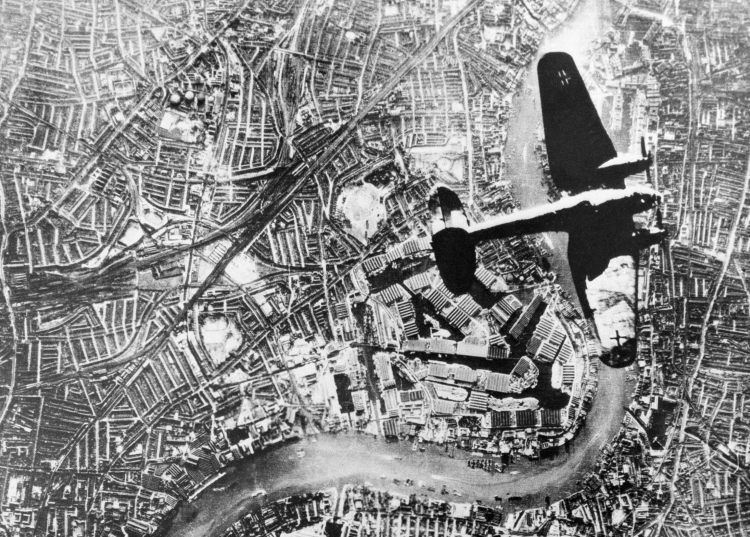
For over two hundred years, Mayfair’s story was one of property, affluence, and economic development. But when the London Blitz began (lasting from Sept. 7, 1940 to May 11, 1941) the area began to suffer alongside the rest of London. It is a period deeply imprinted in collective British historical memory. From 1940 to 1945, an estimated 60,000 British civilians were killed and another 160,000 injured in air raids across the country, as Adolf Hitler’s Luftwaffe attempted to bomb the UK into submission.
May 11, 2026, marks the 85th anniversary of the conclusion of this visceral assault on both London and Mayfair’s fabric and daily life. This month, it will be freshly remembered.
Affluence is No Defense
Barely one week into the Blitz, as hundreds of Luftwaffe Heinkel HE-111, Dornier DO-17 and Junkers JU-88 aircraft raided the capital by night from high level, Mayfair felt the results directly. Grosvenor Square and Berkeley Square (the latter housing a Heavy Rescue depot, barrage balloon teams, a warden reserve centre and an air raid shelter) were both hit by high explosive bombs. City of Westminster archival paper records reveal that on Sept. 11, 1940, bombing wrecked the north-eastern end of the Burlington Arcade. On Sept. 13, a single bomb struck houses on the north side of Berkeley Square and incendiaries damaged property at its southern end. On Sept. 16, a house on Savile Row – a street which remains world famous for its bespoke tailoring – was hit and collapsed. On Sept. 18, a bomb eviscerated flats on Hill Street, just off Berkeley Square. The following night Dover Street was struck, killing two and reducing an 18th century townhouse to rubble. Bombs hit Savile Row again on Sept. 24.
Oct. 1940 saw further wounds inflicted on Mayfair. On Oct. 2, Conduit Street was damaged in a night raid, and on Oct. 9 a block of flats in Grosvenor Street was obliterated. On Oct. 26, 1940, Curzon House, a large block of flats under renovation, suffered a direct hit. Though the exact number was never determined, there were dozens of fatalities. In Nov. 1940, a stick of three falling bombs lacerated the Naval and Military Club on Piccadilly. On the night of Nov. 15, 1940, a single bomb hit Pitts Head Mews, virtually demolishing them. In winter 1940, a bomb caused Mayfair’s oldest standing building to disappear from history. Sunderland House, a huge Mayfair mansion on Curzon Street, was also burnt out by incendiaries, leaving only its grand masonry façade standing.
In response to the rain of bombs, Mayfair’s population either left altogether or sought shelter in local underground basement shelters. Socialite Lady Diana Cooper wrote of her experience taking shelter in the Dorchester Hotel, explaining how she slept on camp beds in the Dorchester’s Turkish Bath and gymnasium while listening to anti-aircraft guns blaze in nearby Hyde Park.
The Mount Street Blast Radius
Mount Street, a particularly smart Mayfair thoroughfare lined with fine Victorian deep red brick and lobster terracotta fronted residences and businesses, was damaged in Sept. 1940 and in April 1941. The main incidents centred on Farm Street Roman Catholic Church, on the Jesuit Residence at 114 Mount Street and on buildings further west at the corner with South Audley Street and with Balfour Place. The Farm Street Church – a beautiful Gothic Revival Catholic Church designed by J.J Scoles and built from 1844 to 1849 – was damaged in Sept. 1940 when an unexploded anti-aircraft shell hit the adjoining Jesuit Residence at 114 Mount Street.
Church staff extinguished two 1kg incendiary bombs burning at the Church in the early hours of Sept. 22, 1940. More severe damage occurred after incendiaries struck the Church roof. The staff had removed lights from the Church's arched window, so it escaped destruction. But fire consumed over one third of the roof, and windows at the Farm Street entrance were lost.
Sifting through the charred debris pile in the Church interior the next day, priests and staff managed to recover their altar vessels, and masses continued in the damaged Mount Street Residence after emergency repairs. On April 17, 1941, the west front of the Church facing Mount Street Gardens – modelled on the 13th century entrance of Beauvais Cathedral in northern France – was wrecked by high explosive blast and shrapnel after a bomb fell close by. After this raid, during which the Luftwaffe dropped over 890 tons of high explosive and 151,000 incendiaries on London, John 'Jock' Colville, Prime Minister Winston Churchill’s 25-year-old Assistant Private Secretary, wrote tersely in his war diary: “Mayfair has suffered – badly.”
Farm Street Church had indeed suffered long term structural damage. Initial repairs under the direction of architect Adrian Gilbert Scott were not completed until 1951. A new Rose Window overlooking the Church’s Farm Street entrance was designed by Evie Horne and installed in the 1950s. A second round of major repairs were necessary in 1977 and 1987. Luckily, the immediate area around the Church survived further direct hits: Mount Street Gardens, and Grosvenor Chapel and Connaught Hotel on Carlos Place all survived.
Mayfair’s Wartime Endurance and Remembrance
Mayfair has other deep wartime associations. From 1942 to 1944, 20 Grosvenor Square housed the military headquarters of General Dwight D. Eisenhower, Supreme Commander of the Allied Expeditionary Force in Europe. Churchill used Mayfair’s Down Street Underground Station, just off Piccadilly, on eight separate occasions between Oct. 23 and Dec. 20, 1940, as his temporary top-secret shelter. This disused Tube station had been repurposed as emergency government offices in 1939 and served effectively as a bunker running Britain’s strategic rail movements during the Second World War.
Unnoticed by passers-by on the Mayfair Streets above, Churchill was spirited in and out of its reinforced steel and concrete entrance to a small elevator in which he descended to the tunnels beneath. Mayfair was also immortalised in the hugely popular and evocative wartime song ‘A Nightingale Sang in Berkeley Square.’ Performed memorably by singer Vera Lynn, the “Forces’ Sweetheart,” the song recalled happier times in Mayfair locales, and captured a yearning for peacetime for both civilians at home and soldiers abroad.
As the first phase of the Blitz unwound, Mayfair remained vulnerable. The heaviest raid of the Blitz, on May 10 and 11 1941, took a serious toll. That night, 555 Luftwaffe bombers dropped 711 tons of high explosive bombs and 86,000 incendiaries across London. Over 1,400 Londoners were killed and over 2,000 others seriously injured. Approximately 10,000 buildings were destroyed or severely damaged. In Mayfair, a falling bomb levelled the southwestern corner of New Bond Street and Bruton Street. At 12:50 a.m. on May 11, a high explosive bomb fell on 1-3 Clarges Street, just off Piccadilly. Eight casualties were reported, of which five were confirmed fatalities. In the subsequent rescue operation, firemen poured water onto walls in an adjacent property to prevent flames reaching a trapped woman who was later pulled out uninjured. At 2:15 a.m., townhouses at Nos. 22-24 Park Lane were heavily damaged (at the site of today's Park Lane Hilton Hotel) and incendiaries gutted Shepherd Market and Hill Street. At 3:10 a.m., a parachute mine floated down to destroy four floors of Mayfair Court on Stratton Street. There were eight casualties, and BBC staff trapped in its basement were later successfully extracted.
May 10 and 11 1941 was the last night of the London Blitz. Hitler’s attention now shifted to execute his grand strategic plan, ‘Operation Barbarossa,’ the invasion of the Soviet Union. For two and a half years bombing on London ceased, until the Luftwaffe resumed conventional bombing during the so-called ‘Little Blitz’ (Jan. to April 1944). On Feb. 23, 1944, John Colville noted in his diary that: “Bombs shook us in Stratton Street (Mayfair). The effect is small on the Luftwaffe's part, but the results are considerable.” Mayfair endured a final, bruising airstrike during the highly destructive V-Weapons campaign (June 13, 1944 to March 29, 1945), after a V1 Flying Bomb struck Conduit Street, off Regent Street on July 17, 1944.
May 11, 2026, marks eighty-five years since the London Blitz ended. The scars of war in Mayfair are long gone. Today’s Mayfair is a restored showcase of London affluence, to put it mildly. Yet just beneath the surface, sounding sirens and Mayfair’s wartime mettle call to the historically minded.