How America Forgot Its Largest Slave Revolt
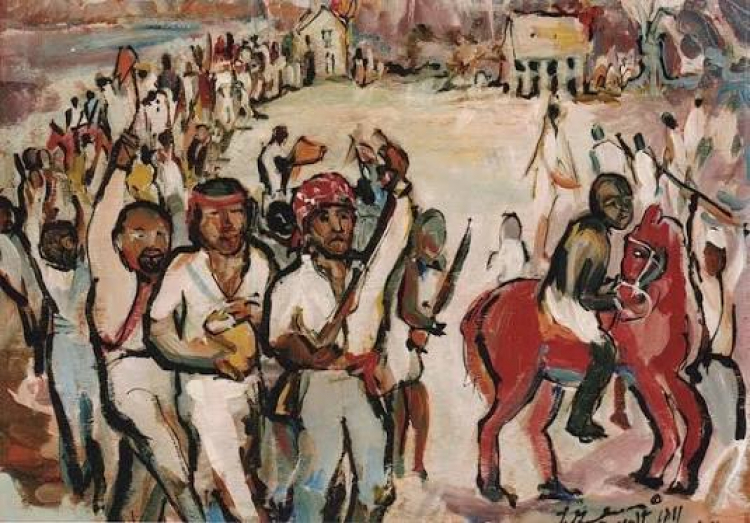
In 1811, several hundred enslaved men walked off the sugar plantations of Louisiana, armed themselves, and began marching toward New Orleans. Their uprising is often described as the largest slave revolt in American history.
Most Americans have never heard of it.
Most Americans know of Nat Turner. They may recognize the names Denmark Vesey or Gabriel Prosser. But few know Charles Deslondes, who led an armed uprising through the plantation country along the Mississippi River and, for a few days in January 1811, terrified the people who controlled Louisiana.
How did a revolt this large nearly vanish from American memory?
Part of the answer begins with Deslondes himself. He was an enslaved man of mixed ancestry who worked as a driver – a position that placed him between the enslaved field workers and those who controlled them. That role likely gave him more freedom of movement and greater contact with other enslaved people. Evidence also connects Deslondes and his family to Saint-Domingue, the French colony transformed by the Haitian Revolution, though much about his early life remains uncertain.
We do know that by January 1811, Charles Deslondes was leading a rebellion.
What we don't know is what he believed would happen if he won.
Deslondes never had the chance to tell us. He left no memoir, no manifesto, no confession, no explanation of what he intended to accomplish. He never stood before a court and gave a final speech. According to a contemporary account, the men who captured him cut off his hands, shot him repeatedly, and burned him in a bundle of straw while he was apparently still alive. Whatever plans he had, died with him.
Twenty years later, Nat Turner left behind something Deslondes never did: his story. After Turner's capture in Virginia, attorney Thomas Ruffin Gray published The Confessions of Nat Turner, based on conversations with Turner before his execution. Historians still debate how accurately Gray recorded Turner's words, but the document gave future generations the story of his rebellion.
Deslondes became something different. He became a name in the records of the people who killed him.
That may be one of the simplest reasons we remember one rebellion and largely forgot the other.
History and memory aren’t the same. An event can be important and still disappear. The stories that survive tend to have people at their center, and those people need someone to preserve their words. Deslondes and his followers left very few. The people who defeated them left plenty.
Governor William C. C. Claiborne wrote letters. Military officers filed reports. Slaveholders gave accounts. Tribunals recorded judgments and death sentences. The government carefully preserved the story of how it responded to the rebellion.
But the rebels left almost nothing explaining why they began it or where they thought it would lead.
We know the broad outlines. On January 8, 1811, enslaved men rose on Manuel Andry’s plantation along the Mississippi River above New Orleans. Andry was wounded and his son killed. The rebels seized weapons and began moving downriver through the plantation country known as the German Coast. As they moved, others joined them.
No one knows exactly how many took part in the rebellion. Estimates vary widely – most often cited between 200 and 500. The force was more than enough to terrify a society built on the belief that a relatively small number of people could keep a much larger population enslaved.
And the rebels were moving toward New Orleans. This is where the story becomes both fascinating and frustrating: What were they going to do when they got there?
Some modern accounts offer a clear answer: Deslondes and his men intended to capture New Orleans, free its enslaved population, and create an independent Black republic modeled on Haiti.
Maybe that was their intention, but we don’t know for certain.
There is no surviving battle plan. There is no declaration written by Deslondes. There is no account from the rebellion’s leadership explaining what victory was supposed to look like. We know the men were moving toward New Orleans. Everything beyond that becomes speculation.
Haiti, however, hangs over the entire story.
Only seven years earlier, enslaved people in the French colony of Saint-Domingue had done what slaveholders throughout the Americas feared most. They had fought back and won. To slaveholders living in Louisiana in 1811, the Haitian Revolution was not distant history – it was recent, frightening news. New Orleans belonged to a Gulf and Caribbean world. Refugees from Saint-Domingue had fled there. Ships and people moved constantly between Louisiana and the Caribbean.
The slaveholders certainly understood what the Haitian revolution meant. Somewhere in the Americas, enslaved people had overthrown the system.
The question is how much that example meant to Deslondes and the men marching with him.
Whatever Deslondes intended, the authorities had no intention of letting him reach New Orleans. Local planter forces, territorial militia, federal troops, and naval personnel mobilized quickly. The rebels had some firearms, but many carried agricultural tools and improvised weapons. Within days, the organized rebellion was broken.
Then came the killing.
Some rebels died in fighting. Others were hunted down. Captured men faced tribunals and death sentences. Three were publicly hanged in the Place d’Armes in New Orleans – today’s Jackson Square. Authorities reportedly placed the heads of rebels and other mutilated remains on poles along the Mississippi River corridor as a warning.
The men who controlled Louisiana wanted the enslaved people living along that river to remember what happened to anyone who followed Charles Deslondes.
The irony is that much of America eventually forgot.
The rebellion was crushed so completely and so quickly that it never became a prolonged national crisis. There was no surviving leader to explain it afterward and no document giving later generations the rebels’ side of the story.
The Civil War would eventually overwhelm almost everything that came before it in America’s memory of slavery. Earlier resistance was remembered unevenly. Nat Turner survived in that memory. Charles Deslondes largely did not.
But there may be a simpler explanation. The German Coast uprising doesn’t give us the kind of story history likes to tell. We don’t know exactly how many men joined it. We don’t know precisely how it was organized. We don’t know how much its leaders were influenced by Haiti. We don’t know whether they intended to create an independent country.
Most of all, we don’t know what victory meant to them.
Those unanswered questions shouldn’t make the uprising less important. They should remind us of something about the way history survives.
The men who governed Louisiana could write letters, publish newspapers, issue orders, hold trials, and preserve official records. Charles Deslondes and the men who followed him had none of those advantages. When the rebellion ended, many were dead.
For several days in January 1811, however, they were very much alive. They walked off plantations along the Mississippi River. They armed themselves. They gathered others. And they started toward New Orleans.