Oaths of Office: Do They Matter?
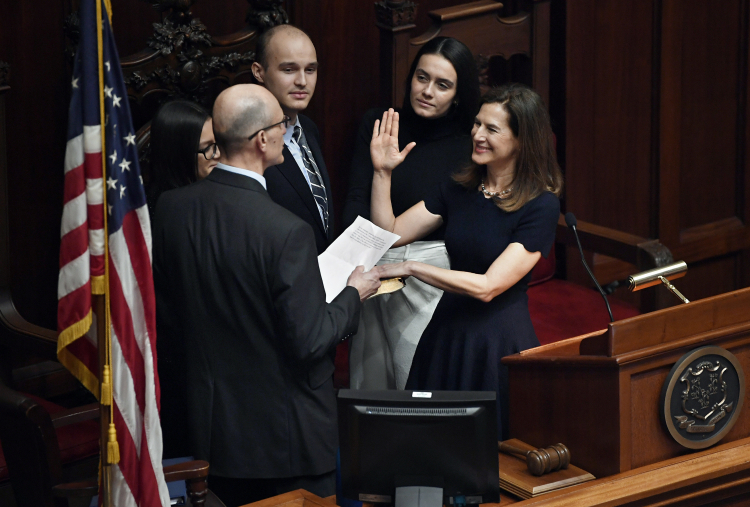
The use of oaths of office in the United States is widespread. At the federal level, oaths are required of the President, Vice President, cabinet officials, members of Congress, civil officials and military members. More broadly, oaths of office have been used throughout history and across nations. What do such oaths require, and do they matter?
Article II, Section 1 of the U.S. Constitution sets out the oath required of a President upon assuming office. The oath has two parts: (1) to faithfully execute the office of President; and (2) to protect, support, and defend, the Constitution. Apart from the Oath, in Section 3, the President is directed to "take care that the laws be faithfully executed."
Article VI requires an oath of office to support the Constitution for members of Congress and state legislatures and for all executive and judicial officers, both of the United States and of the several States. The first Congress to implement Article VI required individuals in the civil service and military to swear or affirm allegiance to the Constitution and to faithfully execute their office. (Currently codified at 5 U.S.C § 3331).
Requiring an oath of office of a government official is not novel. Seven hundred years before the Constitution was ratified in 1788, England used oaths of office. Following the Glorious Revolution, the coronation oath of 1688 required the King of England to govern according to the statutes of Parliament and the nation's laws and customs. Other English office holders were required to take oaths to "faithfully execute" their office.
In colonial American, oaths were routinely required of office holders including colonial governors. After American independence, office holders in the Continental Congress and state governments were required to take oaths that included faithful execution of their offices. Many of the framers themselves would have taken such oaths.
The use of oaths of office predated English and American experience. Magistrates in ancient Athens swore to govern justly according to the laws. Roman officials swore to uphold the law, and the oath of consuls included a promise of true faith and allegiance to the senate and people of Rome.
One theme common to these oaths of office was to govern according to law. In the 13th century, the English jurist Bracton argued that the king must not be under man, but under God and under the law because the law makes the king. The Magna Carta of 1215 prohibited the king's actions against persons except by lawful judgement or peers or the law of the land. Blackstone made the same point concluding that the king's power was limited by the nation's laws. The king, he said, cannot act beyond or in contradiction of the law; it is the king's duty to execute the law, and the king, himself, is subservient to the law of the land.
Much earlier, Aristotle wrote that the law should govern, and rulers were guardians and servants of the law. Alexander Hamilton, in defending the powers the Constitution granted the President, argued in the Federalist Papers that a President who violated the law was liable to removal from office and prosecution for crimes.
A second theme is that government officials are required to act in the best interests of the governed not in the official's interests. This doesn't mean an official may not act in the official's own interests, but it does mean that the official may not act in his own interest if doing so conflicts with the duty to act in the best interests of the governed. This is sometimes expressed as the duty of loyalty, defined as adherence to law and faithfulness to one's prince, sovereign, or government (Black's Law Dictionary).
Finally, do oaths matter? In the three impeachments of U.S. presidents, the charges included violation of the oath of office; the underlying conduct was also charged. George Washington, on his appointment as a major in the Virginia militia, took an oath of allegiance to George III. Robert E. Lee, as member of the U.S. military, took an oath of allegiance to the U.S. Constitution. Both argued that changed circumstances released them from their oaths. In Washington's case, the King and Parliament had violated the law protecting the colonists’ rights as British subjects. Lee's explanation was Virginia's secession from the union.
It would seem Washington and Lee were right that circumstances can justify releasing a person from his oath. Whether the claimed change in circumstances was actually sufficient to justify releasing Washington and Lee from their oaths is a separate issue.
Consider the case of Hitler. He took an oath of allegiance to the German constitution on accepting the position of chancellor in the German government. When the German president died, and Hitler combined the offices of president and chancellor into the office as Fuhrer, Hitler required a new oath of allegiance to Adolf Hitler as the leader of the German government and people. There can be no argument that starting World War II and the Holocaust were sufficient to release any German from an oath of allegiance to Hitler.
Oaths of office do matter, but not so much as a basis for taking action against office holders who break their oath. More importantly, such oaths express a common understanding of how government officials are expected to conduct themselves, executing their office according to law and in the best interests of the governed.